
Before I hit “enter,” I intended to ask Perplexity if business writing principles in the AI age would fit with my existing content. “Yes,” it replied, then advised me on how to judge that — without asking which topic.
Generative AI is often better at following, not leading, sometimes because it’s programmed to serve. It’s still developing.
I’m making the case for following professional business writing grammar rules despite its widerspread use. So, this isn’t about trimming em dashes or other alleged “tells” to avoid being accused of having a robotic touch.
I maintain it’s better to strive for accuracy (like I was taught in school) and will keep aiming for that sheen, with and without AI.
Does being concerned about whether copy was machine-generated make sense?
Large language models behind ChatGPT, Claude, and their cousins learned English from us. Like humans, especially without clear directions and despite access to libraries of knowledge, it can still craft grammatically incorrect rough drafts.
Whoever does it, bad writing can tarnish your image. If you know good grammar and tools, though, AI can be an effective editor. I’ve used it for years, starting with spelling and grammar checks in software like Microsoft Word and Grammarly.
5 Business Writing Principles That Still Matter (Despite AI)
Some businesspeople are “all in” on AI. Others aren’t. In some professional services fields that require accuracy (like law), the use of AI can violate rules of conduct.
Here’s what many business professionals (including me) still struggle with — and AI does and doesn’t resolve effectively.
1. Readability – Unless you’ve given AI tools precise instructions, their output can be wordy and veer into complex terms, padding your editing time. It depends on the topic, the prompt, and the tool, though.
In a 2023 study of patient information materials, ChatGPT improved readability but couldn’t always reach recommended low-grade levels; Google Bard (now Gemini) reached a sixth-grade reading level but sometimes omitted up to 83 percent of the original content.
Even when we use our brains, some of us sound stuffy, writing more for college professors than everyday people. I’ve done it. The occasional long sentence, big word, or chunky paragraph is fine. No harm done. Just remember who you’re writing for and consider if your text reads like mumbo-jumbo.
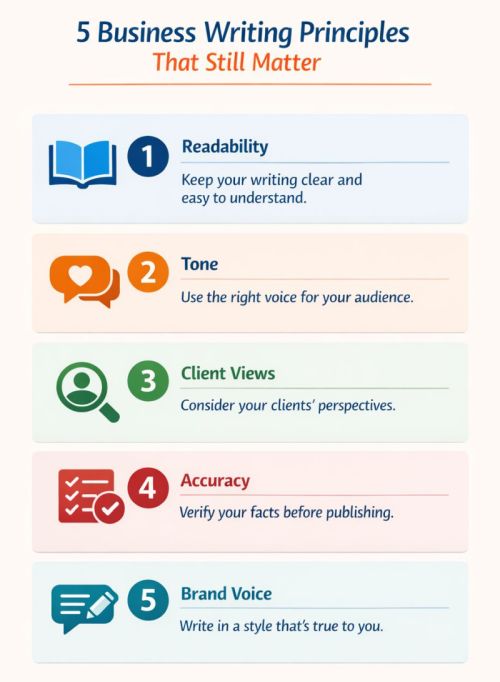
2. Tone – AI can grasp the nuances of emotions based on what has been written. But it can’t see through your eyes. If you’re aiming for a certain tone, it can fail to convey it with the right level of emotional intelligence or “soul.”
Example: If you ask it for advice on respectfully asking a colleague to take out the trash (after the fourth try), AI might suggest:
“Team effort time: Trash is full again — want to grab it, or should I?”
But it might not give you the right wording to discuss the deeper issue: why your colleague keeps forgetting. It can make suggestions, but ultimately, what feels right is your call. And when you need to broach a sensitive topic, wouldn’t it be better to talk than text?
3. Client views – You or AI can dig into data about your clients — your own or by others. That information can help you find problems and predict solutions. You can create avatars that resemble customers and consider what they might say. But you don’t always know what your readers think unless you ask them.
Giving customer data to AI raises ethical and privacy concerns, and for some professional services firms, confidentiality issues with legal consequences. States like California and Utah mandate AI disclosures in consumer interactions and ban unverified use in regulated fields. Ethical violations now include skipping human review in client work.
Unless you prompt it to spot them, AI might also ignore biases in data and rely on stereotypes.
4. Facts – We and AI can fudge details, like miscounting the number of references to “you” in this blog. (Perplexity counted 35, I counted 22.)
How reliable is AI for factual accuracy? Across models like GPT-5.2 and Claude, 2026 benchmarks show hallucination rates of 15 to 52 percent, though techniques like retrieval-augmented generation (RAG) can cut them significantly.
In my experience, for research, among the major AI bots, Perplexity is the most consistently accurate. I appreciate the well-organized links to sources, which, surprisingly, Google’s Gemini doesn’t offer without asking. To an extent, all of the platforms hallucinate — some more than others.
Trust, but verify.
5. Brand voice or writing style – If your content doesn’t sound like you, it lacks authenticity and can fail to reach clients. They’ll see through the false front or ignore copy that looks the same. Generative AI can worsen that by putting words in your mouth, creating more work.
Arguably, only you can add your personality to your writing, because your brand voice reflects how you speak to your customers.
Having a company style guide (or following an existing one like The Chicago Manual of Style) helps you make your copy look and sound more consistent. It can include words to use and avoid, or advice on formatting documents like press releases. The sky’s the limit.
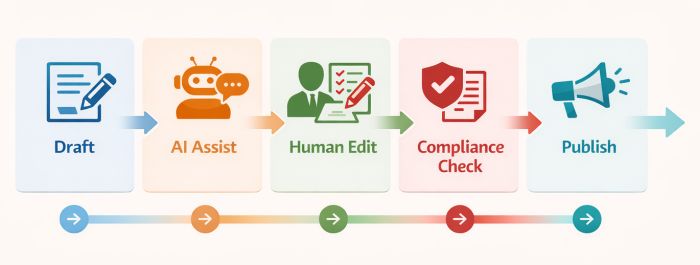
Whether or not you use AI or it continues to improve, we’ll likely keep wrestling with these business writing principles. If you use AI for content creation, consider an “AI-U” process — have a human review the final draft.
Either way, when we strive to create solid business writing, we must take responsibility for our successes or failures — because our writing projects who we are.
Does your content sound like you — or everyone else? A copy audit shows what’s working, what’s not, and how to strengthen your brand voice to connect with clients.
What do you think of AI? Are you checking whose writing has the robotic touch? Leave a comment below.
Business Writing Principles FAQ
According to Scribbr:
Step 1: Prewriting.
Step 2: Planning and outlining.
Step 3: Writing a first draft.
Step 4: Redrafting and revising.
Step 5: Editing and proofreading.
▪️ Run small A/B tests with clear metrics (open rate, clickthrough rate, conversion, time on page) and a defined sample size or time window
▪️ Supplement with qualitative feedback (surveys, user interviews)
▪️ Refine the lower-performing version based on data and brand fit
AI-generated content might not affect search rankings much. But AI can fumble aspects of accessibility like alt-text for images and clear headings by being too generic.
Google’s “people first” content approach remains important. It’s more about your authority and reputation than keywords now (and the rules keep changing!)
Gemini emphasizes that accessibility has become a foundational technical requirement for SEO and AEO (Answer Engine Optimization). Studies show WCAG-compliant sites often see 12 to 23 percent more organic traffic, and guidelines like WCAG 2.1 AA are increasingly standard via the Americans with Disabilities Act and the EU’s Accessibility Act.
SEO (traditional search):
Accessibility can be an indirect factor through core web vitals and UX signals:
▪️ User Experience (UX): Search engines like Google favor sites with high engagement and low bounce rates. Sites with clear contrast, readable fonts, and logical navigation keep users on the page longer.
▪️ Semantic Structure: Using proper through tags is an accessibility requirement for screen readers, but it’s also how Google’s “crawlers” understand the hierarchy behind your text.
AEO (“AI answer” search)
Answer engines (Perplexity, ChatGPT Search, Gemini) don’t just look for keywords, but for LLM-readability.
▪️ Alt Text as “Eyes”: As AI models become multi-modal, they use your image alt text to understand charts and diagrams. If you skip alt text, the AI is “blind” to that data and won’t cite you as a source.
▪️ Parsing the “Answer Block”: AEO favors content that is “liftable.” Clean, accessible formatting (bullet points, numbered lists, short paragraphs) lets an AI “scrape” your answer and credit you with a citation.
▪️ Trust and Authority: Now, AI models favor “clean” code. It sees messy, inaccessible HTML as a sign of lower quality content or “spam.”
QUOTES
“The future of AI isn’t human vs. AI — it’s human with AI.”
~ Kipp Bodnar, CMO HubSpot
“The more reliant marketers become on AI to produce content, the less differentiated that content will feel, which will put a premium on higher quality research and writing.”
~ Brad Wolverton, HubSpot Senior Director of Content
