5 Reasons Why Your Professional Services Branding is Failing (And How to Fix It)

An exhausted woman at desk overwhelmed by multiple screens of professional services branding websites.

In 2026, clients don’t hire professional service firms because they provide helpful information. Studies show they hire based on trust and specific outcomes.

Another major factor in your content marketing visibility: search and social algorithms now emphasize authority, experience, and engagement. They’re key ingredients for building the trust that influences clients to buy.

  • Search: It’s now “answer-driven.” Google’s AI search penalizes content that lacks a distinct point of view. Traditional SEO also focuses on E-E-A-T (Experience, Expertise, Authoritativeness, and Trustworthiness).
  • Social: The LinkedIn algorithm favors trending topics that keep people talking and show your expertise. Lots of “likes” or frequent posting are no longer enough.

So, to win at the content marketing game now, service providers must rise above the sameness that has become standard since before ChatGPT came to town.

Use building trust as framing for how you speak to clients.

You might remember the adage that you have only a few seconds to make a good impression. If you lead with “white bread” copy, you’ve already lost them. Beyond trust building, speaking in a clear voice makes clients curious enough to listen for what they can expect from working with you.

Five Reasons Your Messaging is Invisible

  1. The “same” game: Picture a prospect with six websites open in six tabs. Four of them promise “quality service.” By tab three, the words stop registering — she’s scanning for the promise that shields her business from creditors.

Just because others use stock phrases, it doesn’t mean you should, too. Do they really apply to you or your firm, anyway?

Think less about what you do and more about how you solve clients’ problems. Dig into the details of what you offer.

68% of companies report that brand consistency added 10 to 20% to their revenue growth.

Designrush
  1. Words or strategy?: Professional service firms often treat their website as a digital brochure rather than a sales system or funnel.

Rewriting your homepage copy won’t necessarily fix a failing professional services branding strategy. Part of your strategy is showing the value you offer clients, which helps them trust you. You can convey that in your wording and branding, but it also helps to know the psychological reasons why your clients buy.

Beyond the benefits of working with you, consider how you frame them.

It’s also OK to use emotion to appeal to clients — even in more “buttoned up” industries like law — because we tend to buy based on our feelings, which we back up later with reasoning. No emojis or exclamation points required.

  1. The invisible ideal customer persona (ICP): Professional services branding positioning problems often stem from unclear targeting: when there’s no ICP or one built on gut feelings, not data.

A homepage that tries to speak to a retiring business owner and a young couple writing their first will at the same time ends up speaking clearly to neither.

Who do you help? Define who you serve and narrow your focus. Every engagement is unique: your brand must adapt to different client challenges without losing its voice. Talk to clients and research what they struggle with for a clearer picture of who they are and the problems they want to solve.

Companies with clearly defined ICPs see up to 36% higher conversion rates and 68% higher ROI on targeted campaigns.

CXL
  1. Cognitive load: If you cram eight ideas into 250 words, your readers will look elsewhere. The most authoritative firms explain complex ideas in simple terms.

Here’s an example of a brain-straining tagline:

I work with professionals whose voices have been buried in corporate noise or dismissed as “not strategic enough” — where their expertise is real, but their ability to communicate it doesn’t make an impact. I find what blocks them and help translate their knowledge into clear, confident messaging that positions them as an authority.

A revision that focuses on the outcome:

I help professionals whose voices have been quieted amplify their authority.

Especially with taglines, KISS (keep it simple, stupid) and tell later when you have more room in your article, your book, or your podcast.

Readers decide in the first five seconds whether content is worth reading.

elevation marketing
  1. The AI-voice liability: clichés like “In today’s fast-paced world” or “Unlock your potential” don’t just harm your reputation. Using AI can raise privacy concerns, strain client confidentiality, and put you at odds with industry standards of disclosure.

Designing a Messaging Moat

You’re not the Coca-Cola of consultants. Buyers don’t want a “full-service” firm. They want one that understands their challenges.

Before the Industrial Age, everything was handmade, from the food people ate to the clothing they wore. Professional service firms work the same way. They offer custom services, not mass-produced products.

Professional services sell on outcomes and behavior. A professional services brand strategy should focus on showing specific results clients can expect, not vague benefits, like how your service works (as in product marketing). Emphasize what you deliver regularly — busy or not.

  • Example: We foster brand engagement.
  • Reframed: We stop your website from sounding like everyone else’s.

Questions to Ask to Show Your Expertise

  1. What do you do consistently well that no one else does?
  2. How did you solve that problem for someone? (Reviews are often a popular way to show how, but you don’t have to name names. You can do this in a way that protects client confidentiality.)

“Whatever it is, it should be authentic, valuable, and hard for others to claim.”

brandrusso

If your messaging is vague, you attract the wrong people, wasting time on discovery calls with “looky-loos.” If you resemble everyone else, you must compete on everything, including price. You become the product, not the service provider.

So, don’t be like white bread. Add some flavor to your marketing mix that reflects who you are, like the nuttiness of rye or the tanginess of pumpernickel.

Lean into your authentic voice; don’t be afraid to say what you think rather than playing it safe by stifling an unpopular opinion in your industry. Whether or not people agree with you, as a thought leader, part of standing out is being brave enough to get attention.

Professional Services Branding FAQs

1. What is an example of service branding?


The famous consulting firm McKinsey & Company is a prime example of service branding. Their reputation lets them command premium prices.

McKinsey doesn’t say “We provide quality consulting services.” They call themselves “The world’s most distinguished firm of management consultants” that creates “the change that matters.” Their proprietary research (like the McKinsey 7S Model) backs their expertise.

That’s what professional services branding should look like: specific positioning + demonstrated expertise + measurable outcomes.

McKinsey has also faced controversy, like when they consulted for Purdue Pharma, maker of OxyContin. But despite the scandals, corporate executives and government officials keep seeking McKinsey for advice.

2. What are the 7Ps of service marketing?

To help you define the quality behind your services, this model expands on the 4Ps of marketing:

1. Product: The service being offered (consulting, accounting, law practice, etc.): the behavior and outcomes customers can expect.
2. Price: The value clients will get for the service, priced based on the custom results a firm delivers, which can include subscriptions or tiered packages.
3. Place: Where a firm delivers the service (online, in-home, in an office, etc.).
4. Promotion: How a firm markets its services to its ideal clients (online ads, direct mail, word-of-mouth).
5. People: The providers or staff who work with clients, which affects their overall experience.
6. Process:
How the firm delivers its services.
7. Physical evidence: Where and how the firm delivers its service.

Your Messaging Audit Test

If your content fails these, you have less of a writing problem and more of a strategic positioning problem.

  1. Does this content communicate our custom service approach or could 100 other firms have written it?
  2. Does this reflect our expertise and knowledge or generic industry jargon?
  3. Do we show how we solve the problems our ICP faces?

Building trust is a core part of a professional services brand strategy, but you must communicate the results you bring in a way so that your clients will remember you when they need you.

Now that you have the framework to assess your professional services brand strategy, see how to solve your ideal customer’s problems without straining their brain.

Which piece of corporate-speak would you ban from your industry’s websites forever?

QUOTES

“Professional services brands are built on the behavior of the people in your firm. That means you have limited control over your ‘product.’ The result is that an important focus must be placed on getting consistency in the quality of service your firm delivers.”

~ Lee Fredricksen, Hinge Marketing

“Too many B2B companies blend in because they claim the same things—great customer service, high-quality products, innovative solutions. These are the industry status quo, not differentiators. When everyone sounds the same, no one stands out.”

~ Jaci Russo, brandRUSSO

A 5-Point Professional Services Thought Leadership and Brand Messaging Strategy

Nowadays, an effective brand messaging strategy involves more than accurate information and clean copy, AI slop or not. For instance, AI can explain what a law is, but can’t always pinpoint why your firm’s approach to cases is superior.

So, it makes sense to refocus from informational content to thought leadership that filters your unique expertise through your point of view. Or as Google’s Gemini might say, decision-makers buy from people with strong, proven perspectives, not encyclopedias.

Maybe you lack time to write or plan your content, let alone assemble it or post it. Then there’s the issue of whether anyone will see it or respond.

A hand holds a transparent panel with architectural blueprints, symbolizing a clear brand messaging strategy.

Even with a content creation roadmap, not everyone has a sense of direction. That’s OK, because a skilled creator and strategist like me can guide you.

But if you’re looking for affordable content marketing experts for thought leadership, a price-based approach might not serve you well. You need a content craftsperson — someone with the knowledge, experience, and proven track record of helping people like you reach your goals.

Even if it’s more of an investment than a purchase, the greater recognition and traffic you receive from working with a skilled guide can yield returns.

Here’s how a thought leadership content strategist can differentiate your content without relying heavily on AI, which can tarnish a professional service firm’s reputation.


  1. Thought leadership strategy – Copy that sounds like you — without the overused “It’s not about…”/”It’s about…” comparisons or unnecessary words like “actually” — speaks loudly. It’s your competitive advantage. It gets you seen as a leader in your industry.

What’s more important than cutting the robotic touch or em dashes is that your voice stays clear, setting the right tone for a conversation with your clients.

But churning out content without a plan can backfire. For example, when a firm uses generative AI to create and post five blogs a week to an online community, that can be considered spamming.

Forging a presence without such tactics combines thought leadership with a clear brand messaging strategy through careful, human oversight.

  1. Content governance – Liability and ethical safeguards have always been issues for professional service firms’ content — doubly so with the arrival of ChatGPT and its cousins. An aspiring writer can focus more on the words, but you might be more concerned about not being sued or losing credibility.

A strategic content partner manages the ethical and privacy concerns over feeding data to large language models (LLMs). That includes the issues of client confidentiality, avoiding biased or false data, and the principles of disclosure required in some industry advertising.

If an untrained freelancer or agency employee pastes your proprietary brief, case notes, or strategy into a public LLM (like ChatGPT) to write a blog, they might violate a non-disclosure agreement (NDA) or client confidentiality.

When AI goes unchecked, you face risks like these:

In a recent survey, 47 percent of marketers said they encounter AI errors several times a week, and 37 percent said incorrect AI content has been published.

A skilled strategist protects your firm by enforcing strict limits on the data you let near an AI prompt. I don’t use AI to write articles or longer-form content, and I comply with my clients’ wishes regarding privacy and AI.

3. Risk mitigation – AI hallucination rates can range from 15 to 52 percent. In regulated fields like law, accuracy is a rule of conduct. Hiring for “word count” means the owner still must spend valuable time fact-checking.

A content collaborator oversees reviews for accuracy, so the final draft is ready to publish. I’ve used AI to structure content and gather facts, which I always double-check. It’s part of my “AI-U” trust-but-verify process.

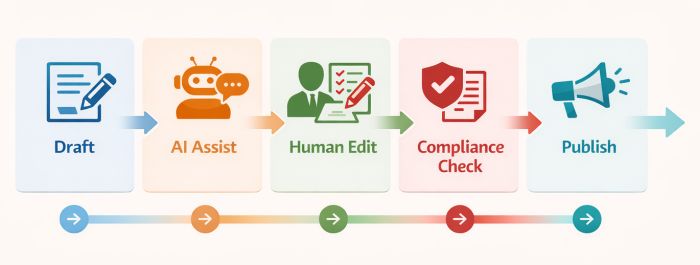
A five-step content framework could look like this:

  1. Draft
  2. AI help
  3. Human edit
  4. Compliance check
  5. Publish

For professional services, the “compliance check” is the most crucial stage.

  1. Content formatting and discoverability – Attractive visual elements make a message a “must see.” Part of that includes ensuring that content appeals to search and “answer engines” like Perplexity or Gemini.

Snippets with short bullet points or paragraphs or distinct descriptions make them more likely to cite you as a source.

  1. Strategic intent and audience alignment – An ability to see the “big picture” — how everything works — ties your plan together. It spans writing with empathy for your clients to knowing which content is more worth a rework than a repost.

AI can create loads of content for search, but the messaging could be weak. Seventy-three percent of consumers surveyed are less likely to buy when brand messaging is mixed or inconsistent.

Generative AI can help firms produce more content, faster, but without critical thinking, that content can drift off-message. And unless you feed it detailed data, AI doesn’t know your ideal customer well — just statistical averages. It often relies on stereotypes because it can’t see through our eyes.

The human edge: a strategic partner helps define your target customer and maps content to the stages of the buyer’s journey, keeping your messaging consistent. A brand strategist also audits copy before publication to ensure it speaks in your brand voice and converts the traffic it attracts.

In my ghostwriting for law firms, I’ve found that mapping content to answer the “burning questions” their audience searches for boosts their click-through rates.

Without a human thought leadership content strategist, reviewing, fact-checking, or rewriting AI-generated copy often takes more time — no matter your settings or prompts.

When you use AI to increase efficiency and sign off on its content, you’re accepting the consequences. But with a skilled human in the mix, you ensure your content gets the time, care, and attention it deserves to enhance your reputation.

Thought Leadership vs. Content Marketing Strategy FAQ

1. What is the difference between content marketing and thought leadership?


Content marketing spreads information that shows how you solve your clients’ problems, spotlighting your expertise to interest them in working with you. Podcasts, videos, blog and social media posts, e-newsletters, and websites are among the most common forms of content marketing.

Through the lens of your expertise, thought leadership gives your point of view on a topic — how you approach your work, what distinguishes you, and why clients should choose you over your competitors.

2. What is a content strategy for thought leadership?


A basic brand messaging strategy can start with an e-newsletter, which you use to feature your blog, video, or other updates, ideally, weekly, biweekly, or monthly. Regular social media posts can also promote the newsletter and other content. Each piece can then be findable in search or AI.

3. What’s an example of a thought leadership content strategy?


A thought leadership content strategy can earn recognition and raise your search visibility. A simple PR-based approach: take a quote from a recent article you wrote and post it to your social media and e-newsletter, or link to the article from your website.

4. What type of content works best for thought leadership?


Any content you post regularly can enhance your thought leadership, even if you start small with social media posts. From there, you could expand into writing a blog or regular columns or articles for publications, which can raise your profile beyond your network.

Find out what your brand messaging strategy lacks — before your competitors do.

When did you last read your own content and think, “That sounds like me”? Leave a comment below.

QUOTES

“Content is fire; social media is gasoline.”

~ Jay Baer, Marketing Strategist

“People don’t buy what you do; they buy why you do it.”

~ Simon Sinek, Author and Leadership Expert

Stop the Waste: 5 Content Repurposing Strategies That Work

If your publishing deadline was yesterday, content repurposing strategies help you catch up and maximize your efforts. Beyond reposting, everything from PowerPoints to white papers can become videos or other creations. An eye for design turns plain text into enticing flyers, posters, or infographics.

Case in point: this blog. The original version from Oct. 2022 was under 500 words and featured a generic stock photo. It wasn’t optimized, nor did it cover what people search for on this topic. The call to action was weak, too.

The update is less of a makeover and more of a new start. It needed that much work. But that’s another repurposing approach: molding the existing “clay” into a clear shape. In this case, I turned a blob into a pentagon to make the content more interesting and less generic, which is crucial for rising above AI slop and gaining more leads.

What is an example of content repurposing?

  • Using a paragraph from a report as a quote in a graphic featured in an e-newsletter
  • Turning an email into a Reddit post

5 Content Repurposing Strategies That Help You Stop Wasting Content (and Time)

My original blog on content repurposing strategies with shorter tips and a stock image.

1. Find your repurpose – Two common content repurposing strategies are timeliness and popularity.

What makes the most sense to follow can depend on your business goals.

Example: An old blog about sharpening widgets is suitable for a refresh if you’re about to sell a gadget to sharpen them.

Seasonal content is also easy to reuse because it often doesn’t need many changes.

Metrics like these can reveal a winner:

  • pageviews
  • opens
  • shares
  • replies
  • leads
  • click-throughs

For instance, the original version of this blog sparked newsletter sign-ups and earned a decent open rate (33 percent). But the information gaps left room for improvement.

2. Tools and workflows – A basic standard operating procedure (SOP), template, or outline gives you a head start and helps you repeat the system. Based on the type of content, your plan may vary.

When I revisited this blog, I researched questions people ask, including overlooked subtopics. Then I used my blog creation SOP to rework the draft and considered missing information. I also reviewed the quality of the text and images.

AI aids in research, analyzing metrics, and choosing the angle or direction.

Graphics editors like Adobe Photoshop and Canva (especially with its many templates) offer inspiration, as can swipe files or libraries of proven copy.

3. Reframing without the SEO pain – Sometimes, cutting and pasting something published online elsewhere “as is” can work against you. It’s more of a repost than a repurpose.

Duplicate web content can get kicked out of Google. (Ask me how I know.) Try to trim or adapt the copy instead. If much of the new piece is the same, like a republished blog, link to the original post at the top and bottom, so Google knows which version is the canonical link, or primary version, for indexing.

If you’re cross-posting to Medium or LinkedIn, use their built-in “canonical URL” settings to ensure Google sees your website as the main source.

Get creative, because you have options. Vary the message. Consider changing the format, angle, or depth.

4. Adapting for different platforms – You might know you want to recycle a video script, but how do you decide what to turn it into? Popularity can guide your decision, which could also depend on your target audience and platform.

With a few tweaks, the script might become a well-received speech or a podcast. It’s like deciding what to post on LinkedIn versus X/Twitter. The audience and the feel differ slightly. One style doesn’t always work the same elsewhere.

I’ve reused my e-newsletter content as:

  • a blog (linked from the e-newsletter)
  • listicle infographics
  • videos
  • lead-generating LinkedIn posts

What you change also depends on the tone, length, and structure. You don’t need to reinvent the wheel, but it doesn’t hurt to redesign it to get you to your destination faster.

Once you’ve finished creating content, don’t let the value end there. Use these strategies for repurposing content in newsletters.

5. Track your changes – Measuring which content nets leads, impressions, engagement, or click-throughs helps you see what to double-down on, and can inspire new ways to reuse it.

Your decision doesn’t always have to be based on popularity. It can be based on the potential to gain more traffic, which is why I reworked this blog.

Tracking engagement might involve checking Google Analytics or adding UTM codes to links. Generally, links at the top of an article or newsletter, where readers tend to look first, could outperform those in the middle or at the end. Also, the results can vary by the platform. Orbit Media offers a useful UTM code formatting tool.


When you consider content to repurpose, to make it worthwhile, remember to assess:

  1. Its popularity or potential.
  2. If it fits your current marketing goals.
  3. Whether the topic is timely (in the news, tied to an upcoming holiday, anniversary, etc.).
  4. If you have templates, tools, or a process to recreate it efficiently, because it could require more work than it does at first glance. Think “reframe” (a piece), not “revamp” (the whole or time sink).

To get seen, it doesn’t have to be green. It can even be evergreen. If it looks like it has “curb appeal,” anything you’ve already created is fair game.

The right repurposing strategy turns past efforts into future action — so your best work keeps working.

How do you repurpose your content? Feel free to comment further below.

Content Repurposing Strategies FAQs

1. How often should I repurpose content?

You might worry that reusing content often will overwhelm you, your team, or your audience. The four steps above can guide you. There’s no limit to how often you should repurpose content because you’re turning something old into something new — even if it revisits a familiar theme.

2. How does a content repurposing workflow work?

After you decide what to repurpose, this is the next step. A basic workflow:

▪️ Decide what form the content will take. Where your target audience spends time can guide you. If redoing the whole rather than tweaking parts could get stronger results, rethink the effort or adjust accordingly.
▪️ Plan how you’ll transform the content or where it will appear.
▪️ Adapt it to the platform or medium. Tools or templates can be specific to the platform or media (like video editors for videos).
▪️ Make sure the final content aligns with your business goals and brand voice. For larger firms, a style guide helps maintain consistency.

3. How do you handle repurposing one idea across multiple platforms?

If you’ve never recycled content, it can be hard to decide what to recreate and how, let alone posting it to several places. Some methods take more time and effort. An easy starting point is a “cross-posting” method that involves few changes.

Example: Reposting a short video made for YouTube to LinkedIn. Shorts generally already have captions included, so you might need to make only a few edits for length or to rewrite the video description into a LinkedIn post that features the clip.

4. How do you repurpose long-form content into short, engaging social media posts?


Example: Take one section, idea, quote, or clip from a 2,000-word blog and turn it into a social post. Think “bite-size” takeaway, not a full summary, which can overwhelm readers. Ask yourself, “What’s the most attention-getting point?” Again, the four steps above can help you narrow down your options.

In the process, you might need to make a new opener, a new ending, or other changes. For text-based posts, an eye-catching image from the blog — or a new one — can draw attention.

QUOTES

“Rather than waste or eliminate items which you don’t currently use, discover a new way to improve and enjoy their value.”

~ Susan C. Young

“Content repurposing is about getting the maximum return from every single piece of content you create. Content repurposing can take many forms, and there are lots of different and creative ways you can repurpose your content, but every content creator must repurpose.”

~ Amy Woods

5 Business Writing Principles AI Can’t Fully Resolve

Before I hit “enter,” I intended to ask Perplexity if business writing principles in the AI age would fit with my existing content. “Yes,” it replied, then advised me on how to judge that — without asking which topic.

Generative AI is often better at following, not leading, sometimes because it’s programmed to serve. It’s still developing.

I’m making the case for following professional business writing grammar rules despite its widerspread use. So, this isn’t about trimming em dashes or other alleged “tells” to avoid being accused of having a robotic touch.

I maintain it’s better to strive for accuracy (like I was taught in school) and will keep aiming for that sheen, with and without AI.

Does being concerned about whether copy was machine-generated make sense?

Large language models behind ChatGPT, Claude, and their cousins learned English from us. Like humans, especially without clear directions and despite access to libraries of knowledge, it can still craft grammatically incorrect rough drafts.

Whoever does it, bad writing can tarnish your image. If you know good grammar and tools, though, AI can be an effective editor. I’ve used it for years, starting with spelling and grammar checks in software like Microsoft Word and Grammarly.

A clean linear flowchart with five stages: Draft, AI Assist, Human Edit, Compliance Check, Publish.

5 Business Writing Principles That Still Matter (Despite AI)

Some businesspeople are “all in” on AI. Others aren’t. In some professional services fields that require accuracy (like law), the use of AI can violate rules of conduct.

Here’s what many business professionals (including me) still struggle with — and AI does and doesn’t resolve effectively.

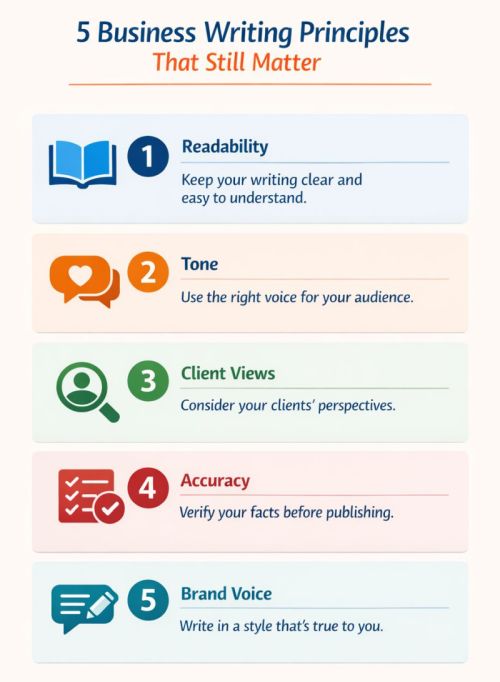
1. Readability – Unless you’ve given AI tools precise instructions, their output can be wordy and veer into complex terms, padding your editing time. It depends on the topic, the prompt, and the tool, though.

In a 2023 study of patient information materials, ChatGPT improved readability but couldn’t always reach recommended low-grade levels; Google Bard (now Gemini) reached a sixth-grade reading level but sometimes omitted up to 83 percent of the original content.

Even when we use our brains, some of us sound stuffy, writing more for college professors than everyday people. I’ve done it. The occasional long sentence, big word, or chunky paragraph is fine. No harm done. Just remember who you’re writing for and consider if your text reads like mumbo-jumbo.

Five business writing principles that still matter: readability, tone, client views, facts, and brand voice.

2. Tone – AI can grasp the nuances of emotions based on what has been written. But it can’t see through your eyes. If you’re aiming for a certain tone, it can fail to convey it with the right level of emotional intelligence or “soul.”

Example: If you ask it for advice on respectfully asking a colleague to take out the trash (after the fourth try), AI might suggest:

“Team effort time: Trash is full again — want to grab it, or should I?”

But it might not give you the right wording to discuss the deeper issue: why your colleague keeps forgetting. It can make suggestions, but ultimately, what feels right is your call. And when you need to broach a sensitive topic, wouldn’t it be better to talk than text?

3. Client views – You or AI can dig into data about your clients — your own or by others. That information can help you find problems and predict solutions. You can create avatars that resemble customers and consider what they might say. But you don’t always know what your readers think unless you ask them.

Giving customer data to AI raises ethical and privacy concerns, and for some professional services firms, confidentiality issues with legal consequences. States like California and Utah mandate AI disclosures in consumer interactions and ban unverified use in regulated fields. Ethical violations now include skipping human review in client work.

Unless you prompt it to spot them, AI might also ignore biases in data and rely on stereotypes.

4. Facts – We and AI can fudge details, like miscounting the number of references to “you” in this blog. (Perplexity counted 35, I counted 22.)

How reliable is AI for factual accuracy? Across models like GPT-5.2 and Claude, 2026 benchmarks show hallucination rates of 15 to 52 percent, though techniques like retrieval-augmented generation (RAG) can cut them significantly.

In my experience, for research, among the major AI bots, Perplexity is the most consistently accurate. I appreciate the well-organized links to sources, which, surprisingly, Google’s Gemini doesn’t offer without asking. To an extent, all of the platforms hallucinate — some more than others.

Trust, but verify.

5. Brand voice or writing style – If your content doesn’t sound like you, it lacks authenticity and can fail to reach clients. They’ll see through the false front or ignore copy that looks the same. Generative AI can worsen that by putting words in your mouth, creating more work.

Arguably, only you can add your personality to your writing, because your brand voice reflects how you speak to your customers.

Having a company style guide (or following an existing one like The Chicago Manual of Style) helps you make your copy look and sound more consistent. It can include words to use and avoid, or advice on formatting documents like press releases. The sky’s the limit.


Whether or not you use AI or it continues to improve, we’ll likely keep wrestling with these business writing principles. If you use AI for content creation, consider an “AI-U” process — have a human review the final draft.

Either way, when we strive to create solid business writing, we must take responsibility for our successes or failures — because our writing projects who we are.

Does your content sound like you — or everyone else? A copy audit shows what’s working, what’s not, and how to strengthen your brand voice to connect with clients.

What do you think of AI? Are you checking whose writing has the robotic touch? Leave a comment below.

Business Writing Principles FAQ

1. What are the five stages of business writing?

According to Scribbr:

Step 1: Prewriting.
Step 2: Planning and outlining.
Step 3: Writing a first draft.
Step 4: Redrafting and revising.
Step 5: Editing and proofreading.

2. How should I evaluate whether AI-written copy performs?

▪️ Run small A/B tests with clear metrics (open rate, clickthrough rate, conversion, time on page) and a defined sample size or time window
▪️ Supplement with qualitative feedback (surveys, user interviews)
▪️ Refine the lower-performing version based on data and brand fit

3. Will AI-generated copy affect my SEO or search rankings?

AI-generated content might not affect search rankings much. But AI can fumble aspects of accessibility like alt-text for images and clear headings by being too generic.

Google’s “people first” content approach remains important. It’s more about your authority and reputation than keywords now (and the rules keep changing!)

Gemini emphasizes that accessibility has become a foundational technical requirement for SEO and AEO (Answer Engine Optimization). Studies show WCAG-compliant sites often see 12 to 23 percent more organic traffic, and guidelines like WCAG 2.1 AA are increasingly standard via the Americans with Disabilities Act and the EU’s Accessibility Act.

SEO (traditional search):

Accessibility can be an indirect factor through core web vitals and UX signals:

▪️ User Experience (UX): Search engines like Google favor sites with high engagement and low bounce rates. Sites with clear contrast, readable fonts, and logical navigation keep users on the page longer.
▪️ Semantic Structure: Using proper through tags is an accessibility requirement for screen readers, but it’s also how Google’s “crawlers” understand the hierarchy behind your text.

AEO (“AI answer” search)

Answer engines (Perplexity, ChatGPT Search, Gemini) don’t just look for keywords, but for LLM-readability.

▪️ Alt Text as “Eyes”: As AI models become multi-modal, they use your image alt text to understand charts and diagrams. If you skip alt text, the AI is “blind” to that data and won’t cite you as a source.
▪️ Parsing the “Answer Block”: AEO favors content that is “liftable.” Clean, accessible formatting (bullet points, numbered lists, short paragraphs) lets an AI “scrape” your answer and credit you with a citation.
▪️ Trust and Authority: Now, AI models favor “clean” code. It sees messy, inaccessible HTML as a sign of lower quality content or “spam.”

QUOTES

“The future of AI isn’t human vs. AI — it’s human with AI.”

~ Kipp Bodnar, CMO HubSpot

“The more reliant marketers become on AI to produce content, the less differentiated that content will feel, which will put a premium on higher quality research and writing.”

~ Brad Wolverton, HubSpot Senior Director of Content

Attract the Right Customers With Clear and Concise Business Communication: Examples

The cross-outs and second-guesses behind clear and concise business communication are often invisible — like with earlier drafts of this blog.

Red thread tangled, then straight, symbolizing clear and concise business communication examples.

It started life as a mish-mash of three smaller blogs. Step 3 about tone came after step 2 about how to plan and draft. One section read like a college lecture, the next like a casual email. It looked like I’d written it in a whisky-induced haze, but I hadn’t touched a drop.

Even professional writers create ugly first drafts. The difference lies in how we mold the mud into text that makes sense.

Beyond easy understanding, the effects of concise writing are concrete.

For instance, Grammarly estimates poor communication costs U.S. businesses $1.2 trillion annually. Conversely, Towers Watson found that companies with effective communication practices deliver 47 percent higher total returns.

To quote William Zinsser, author of “Writing to Learn,” “Clear thinking becomes clear writing: one can’t exist without the other.” The real work often starts before you write: connecting the dots of your thoughts using logic and reasoning. Without that, you end up rambling on the page.

Here’s how to think clearly to write clearly from start to finish.

See the power of clear and concise business communication examples in keeping readers engaged.

5 Clear and Concise Business Communication Steps – With Examples

A bald man, overlay: computer consultant, dog owner, earns $88,000 — clear and concise communication.

1. Know your reader – What do they look like? Where do they live? What do they do? Thinking about them can help you refine your concept, the structure, and the language you’ll use to reach them.

If you write marketing copy like emails or brochures, you might create a sketch or “buyer persona” of your target client. That involves researching problems they need to solve, which helps you learn their lingo, or if they’re “yea,” “nay,” or neutral about your product or service.

Copy that got results before also reveals clues for where to dig deeper. Talking to your audience directly helps you learn how they think and respond.

2. Finetune your tone – Will it be formal, conversational, casual, or a mix? It often depends on your industry, your target market, and your business. For instance, law firms can be more “buttoned up” than plumbers. They often take a more formal tone, especially if their clients are also well-educated.

The most formal tone often lacks humor or lightheartedness, which can smooth the way to broaching sensitive topics.

Whether humor is acceptable depends on the context and the audience. The American Bar Association cautions lawyers against using dramatic music, outlandish settings, or slapstick routines in advertising, noting these undermine confidence in the legal profession.

A lighthearted legal writing example:

Estate Planning is Like Ice Cream — The Best Plan is the One That Doesn’t Melt (Farr Law Firm)

For a more professional tone, if in doubt, leave it out. Share only what you’d feel comfortable discussing with a grocery clerk. Some people veer into foul language or topics not tied to their work. If it draws your ideal readers, that’s fine. But depending on the context and your market, courting controversy could harm your image.

Though you might have to follow industry standards, don’t be afraid to add your “soul” to your writing.

Example: If care and compassion are among your core values, weave them into your copy. Show how you treat others. “When you’re feeling down, we’re ready to listen anytime, day or night.”

Appeal to customers through speaking in your brand voice to reflect your unique image. Share your beliefs and your work process — what drives you to serve others? What distinguishes your business? Who do you serve (or not serve)? Use your unique selling proposition (USP) or tagline (often a shorter USP) as a starting point.

Creating or following a company style guide helps the right ones relate to you and keeps your messaging consistent.

Psychology tells us the easier something is to read, the more likely readers are to believe it’s true. Complex sentences force the brain to work harder, which creates a feeling of friction or risk. Clear writing isn’t just kind; it feels safer to buyers.

Some experts suggest the average sentence be only 16 words. The length also depends on the educational level you’re aiming for, which goes by grade level (in the U.S.).

The tone can also affect readability. Too many “big words” might not reach the everyday reader. The National Center for Education Statistics reports that 54 percent of U.S. adults read below the equivalent of a sixth-grade level.

Accessibility — making sure people with visual or cognitive impairments can read and understand your writing — is another crucial part of readability.

Quick tips:

  • Choose smaller words. Some of us like “ten-dollar” terms because they sound more important or intellectual. Too many can sound arrogant. Skip the formality and favor simpler terms. One way to achieve this is to watch your syllables, the parts of words we place stress on when we pronounce them. Words with one or two are obviously shorter than those with three or four.

Examples:

  • utilize vs. use
  • assist vs. help

Simpler wording makes you look more, not less, intelligent. In a study, readers consistently rated authors of text written with simple words as smarter than those who used complex ones.

3. Build your information – After you’ve gotten more familiar with your client, you might wonder, How should I structure this so they can scan it quickly? Plan, draft, and format.

  • Decide how much information to cover. About how many words long?
  • State your theme or goal in one sentence to guide you to stay on topic.
  • Determine the format and structure — outline the key points. For short works, a few thoughts are fine. Breaking your idea into numbered steps helps organize your thoughts.
  • Read prose by Ernest Hemingway, E.B. White, William Zinsser, or the greats in your genre as examples of how to get to the point without losing context.
  • AIDA: Attention-Interest-Desire-Action (marketing copy): spark curiosity, encourage action, and let readers know what’s in it for them.
  • The 5Ws and the H: Who? What? When? Where? Why? and How?: As part of critical thinking — based on information you’ve gathered, connect the parts logically, building on each answer. Talking to others about your concept before you begin can help you sharpen your focus.
  • Calls to action: In marketing copy, influence readers to act on an offer or provide valuable takeaways — write one or more simple calls to action (CTAs).

Before: “Contact us today to learn more about estate planning.”
After: “Protect your family’s future – book your free consultation today.”

On the average web page, users read at most 28 percent of the words; 20 percent is more likely (Nielsen Norman Group). Where you place text and how you place it matters.

  • The beginning: Make an interesting statement like a quote, a description, a question. Or start with a story.
  • The ending: Wrap up or offer “next steps.”
  • The less messy middle:
    • Beyond words, add interesting images that don’t look staged or other design elements.
    • Add white space so everything doesn’t look too crowded.
    • Bullet points or numbers: Use them to break up concepts into a series of easy-to-follow steps. They’re also good for shortening longer sentences when you don’t want to rewrite everything.
    • Responsiveness: Remember that a four-line paragraph on your laptop looks like a massive block of text on a smartphone. For mobile users, keep your paragraphs to 1–3 sentences to prevent thumb-scrolling (and eye-rolling) fatigue.

4. Editing – How can I shorten this without losing the meaning?

After you’ve finished a draft and let it rest — if possible, for at least a day or so — you can examine it with fresh eyes.

A screenshot of Hemingway Editor showing text analysis for clear and concise communication skills.
  • Shorten your sentences: Sentences that go on and on tend to cause readers to lose focus. Omit needless words (Strunk and White). If a passage reads well without a word or phrase, cut it. The Hemingway App shows wordy passages and the overall average reading level.
  • A sign that a sentence might be too long: too many commas. To break a sentence into two (or more), replace them with periods. Too many short sentences in a row can become boring and repetitive, so vary the length and rhythm of your passages. To shorten your words, move from the specific (more words) to the general (fewer).

Specific: Wills and trusts
General: Estate plan

Include only enough information to get your points across. If a statement isn’t clear enough, add more details. It’s a crucial part of reading comprehension. What are some concise writing examples?

Before: “In order to provide you with the best possible service, we are reaching out to inform you that we will be making some changes to our scheduling system.” (30 words)
After: “We’re updating our scheduling system to ease bookings.” (9 words)

The passive voice creates wordy, weak sentences where the subject receives the action rather than doing it.

  • Passive: The report was reviewed by the manager. (7 words)
  • Active: The manager reviewed the report. (5 words)

Switching to the active voice instantly cuts clutter and adds life to your copy.

Example: Without an explanation, law Latin like “inter vivos,” which means “while alive” — is foreign language. For audiences unfamiliar with the terms, it’s often better to skip jargon.

Write full descriptions of acronyms.

Example: WWF. It can mean anything from the World Wildlife Fund to the former World Wrestling Federation.

40 percent of workers say poor communication reduces their trust in leadership and their team.

2024 Forbes Advisor survey

5. Staying concise through being preciseA report by Josh Bernoff revealed that 81 percent of people who write for work agree that “Poorly written material wastes my time.”

If your audience isn’t educated or doesn’t care, you might get away with typos or grammar fails. But clients who prize your skills appreciate clear and correct copy. They’re also often willing to pay more for access to your knowledge and experience.

I’ve seen fellow service providers brag about client results in typo-filled LinkedIn posts, convinced it doesn’t matter for “casual” social media. Then someone mentions the errors in the comments.

It happened to me once on X — an acquaintance replied, spotlighting my mistake. I felt that all anyone would remember was the error. Professionalism doesn’t have an off switch. You never know who’s watching – or who’s screenshot-ready.

Professionalism can also involve choosing the right words. For instance, some words sound alike but have different meanings, which can prevent you from achieving clear writing for business. If you don’t know the definition, look it up.

Example: “effect” vs. “affect”:

  • The new pricing strategy will affect our quarterly revenue projections.
  • The new pricing strategy had a positive effect on our quarterly revenue.

A GrammarGirl trick for remembering the difference:

  • The arrows affected the aardvark.
  • The effect was eye-popping.

More precise wording can also help you trim the fat.

Before: “Someone who receives benefits from a trust” (8 words)
After: beneficiary (1 word)


Clear and Concise Business Communication FAQ

1. What are the 5 Cs of Effective Business Writing?


▪️ Clear
▪️ Concise
▪️ Correct
▪️ Courteous
▪️ Complete

They can make the difference between writing that stands out or fades into the background. Carefully considering each element can enliven your writing.


2. How do I revise my own writing when I’m too close to it?


▪️ Have another set of eyes see it — preferably a friend or colleague with grammar skills you trust who will give constructive criticism. If no one else is available or you need more feedback, a professional like me can help.
▪️ Use AI, which can range from a simple grammar or spell-check in Microsoft Word or Grammarly to asking apps like Claude how to improve it. But remember: it’s called artificial intelligence for a reason. AI can spot a misplaced comma. But it won’t tell you your opening paragraph sounds like every other estate planning firm’s. A human can spot what makes YOU different and worth hiring. Always have a human comb through your copy.

3. Which words or phrases make writing sound vague, pompous, or unclear?

Some common words and phrases:

▪️ Pompous (overly important sounding): Utilize, leverage, prioritize
▪️ Vague or unclear: maybe, I guess, perhaps, might

4. How should I handle disclaimers or necessary fine print without cluttering the message?

▪️ Create a separate web page for disclaimers to link back to from an e-newsletter or other marketing materials. On social media profiles or in e-newsletters, add a one or two-sentence disclaimer at the end.
▪️ Ensure your fine print isn’t too fine. For example, light gray text on a white background (low contrast) is unreadable for many. Check that it meets ADA (Americans with Disabilities Act) standards for contrast so you don’t ignore visually impaired readers.

5. How do I keep my tone consistent across emails, reports, and presentations?


▪️ Create a company style guide – It can help you or your employees clarify your wording, punctuation, and formatting. It may also set your design standards, from the logos and fonts to the colors you use. Update it regularly.
▪️ Enforce company communication policies – Use your guide to ensure all your messaging stays on brand. Stick to your talking points to maintain consistency.

Do regular content or messaging audits. Your communications policy may also outline crisis communication strategies for clear and concise business communication.

How do you think clearly to write clearly? Feel free to comment below.

QUOTES

“Clarity is the most important characteristic of good business writing.”

Mignon Fogarty, Grammar Girl Quick and Dirty Tips for Better Writing

“Anyone who can think clearly can write clearly. But neither is easy.”

William Feather