
Attract the Right Customers With Clear and Concise Business Communication: Examples
The cross-outs and second-guesses behind clear and concise business communication are often invisible — like with earlier drafts of this blog.

It started life as a mish-mash of three smaller blogs. Step 3 about tone came after step 2 about how to plan and draft. One section read like a college lecture, the next like a casual email. It looked like I’d written it in a whisky-induced haze, but I hadn’t touched a drop.
Even professional writers create ugly first drafts. The difference lies in how we mold the mud into text that makes sense.
Beyond easy understanding, the effects of concise writing are concrete.
For instance, Grammarly estimates poor communication costs U.S. businesses $1.2 trillion annually. Conversely, Towers Watson found that companies with effective communication practices deliver 47 percent higher total returns.
To quote William Zinsser, author of “Writing to Learn,” “Clear thinking becomes clear writing: one can’t exist without the other.” The real work often starts before you write: connecting the dots of your thoughts using logic and reasoning. Without that, you end up rambling on the page.
Here’s how to think clearly to write clearly from start to finish.
5 Clear and Concise Business Communication Steps – With Examples

1. Know your reader – What do they look like? Where do they live? What do they do? Thinking about them can help you refine your concept, the structure, and the language you’ll use to reach them.
If you write marketing copy like emails or brochures, you might create a sketch or “buyer persona” of your target client. That involves researching problems they need to solve, which helps you learn their lingo, or if they’re “yea,” “nay,” or neutral about your product or service.
Copy that got results before also reveals clues for where to dig deeper. Talking to your audience directly helps you learn how they think and respond.
2. Finetune your tone – Will it be formal, conversational, casual, or a mix? It often depends on your industry, your target market, and your business. For instance, law firms can be more “buttoned up” than plumbers. They often take a more formal tone, especially if their clients are also well-educated.
Appropriateness
The most formal tone often lacks humor or lightheartedness, which can smooth the way to broaching sensitive topics.
Whether humor is acceptable depends on the context and the audience. The American Bar Association cautions lawyers against using dramatic music, outlandish settings, or slapstick routines in advertising, noting these undermine confidence in the legal profession.
A lighthearted legal writing example:
Estate Planning is Like Ice Cream — The Best Plan is the One That Doesn’t Melt (Farr Law Firm)
For a more professional tone, if in doubt, leave it out. Share only what you’d feel comfortable discussing with a grocery clerk. Some people veer into foul language or topics not tied to their work. If it draws your ideal readers, that’s fine. But depending on the context and your market, courting controversy could harm your image.
Personality
Though you might have to follow industry standards, don’t be afraid to add your “soul” to your writing.
Example: If care and compassion are among your core values, weave them into your copy. Show how you treat others. “When you’re feeling down, we’re ready to listen anytime, day or night.”
Appeal to customers through speaking in your brand voice to reflect your unique image. Share your beliefs and your work process — what drives you to serve others? What distinguishes your business? Who do you serve (or not serve)? Use your unique selling proposition (USP) or tagline (often a shorter USP) as a starting point.
Creating or following a company style guide helps the right ones relate to you and keeps your messaging consistent.
Readability and cognitive fluency
Psychology tells us the easier something is to read, the more likely readers are to believe it’s true. Complex sentences force the brain to work harder, which creates a feeling of friction or risk. Clear writing isn’t just kind; it feels safer to buyers.
Some experts suggest the average sentence be only 16 words. The length also depends on the educational level you’re aiming for, which goes by grade level (in the U.S.).
The tone can also affect readability. Too many “big words” might not reach the everyday reader. The National Center for Education Statistics reports that 54 percent of U.S. adults read below the equivalent of a sixth-grade level.
Accessibility — making sure people with visual or cognitive impairments can read and understand your writing — is another crucial part of readability.
Quick tips:
- Choose smaller words. Some of us like “ten-dollar” terms because they sound more important or intellectual. Too many can sound arrogant. Skip the formality and favor simpler terms. One way to achieve this is to watch your syllables, the parts of words we place stress on when we pronounce them. Words with one or two are obviously shorter than those with three or four.
Examples:
- utilize vs. use
- assist vs. help
Simpler wording makes you look more, not less, intelligent. In a study, readers consistently rated authors of text written with simple words as smarter than those who used complex ones.
3. Build your information – After you’ve gotten more familiar with your client, you might wonder, How should I structure this so they can scan it quickly? Plan, draft, and format.
Plan:
- Decide how much information to cover. About how many words long?
- State your theme or goal in one sentence to guide you to stay on topic.
- Determine the format and structure — outline the key points. For short works, a few thoughts are fine. Breaking your idea into numbered steps helps organize your thoughts.
- Read prose by Ernest Hemingway, E.B. White, William Zinsser, or the greats in your genre as examples of how to get to the point without losing context.
Writing frameworks:
- AIDA: Attention-Interest-Desire-Action (marketing copy): spark curiosity, encourage action, and let readers know what’s in it for them.
- The 5Ws and the H: Who? What? When? Where? Why? and How?: As part of critical thinking — based on information you’ve gathered, connect the parts logically, building on each answer. Talking to others about your concept before you begin can help you sharpen your focus.
- Calls to action: In marketing copy, influence readers to act on an offer or provide valuable takeaways — write one or more simple calls to action (CTAs).
Before: “Contact us today to learn more about estate planning.”
After: “Protect your family’s future – book your free consultation today.”
Format: How to keep fanning their desire to learn more
On the average web page, users read at most 28 percent of the words; 20 percent is more likely (Nielsen Norman Group). Where you place text and how you place it matters.
- The beginning: Make an interesting statement like a quote, a description, a question. Or start with a story.
- The ending: Wrap up or offer “next steps.”
- The less messy middle:
- Beyond words, add interesting images that don’t look staged or other design elements.
- Add white space so everything doesn’t look too crowded.
- Bullet points or numbers: Use them to break up concepts into a series of easy-to-follow steps. They’re also good for shortening longer sentences when you don’t want to rewrite everything.
- Responsiveness: Remember that a four-line paragraph on your laptop looks like a massive block of text on a smartphone. For mobile users, keep your paragraphs to 1–3 sentences to prevent thumb-scrolling (and eye-rolling) fatigue.
4. Editing – How can I shorten this without losing the meaning?
After you’ve finished a draft and let it rest — if possible, for at least a day or so — you can examine it with fresh eyes.

- Shorten your sentences: Sentences that go on and on tend to cause readers to lose focus. Omit needless words (Strunk and White). If a passage reads well without a word or phrase, cut it. The Hemingway App shows wordy passages and the overall average reading level.
- A sign that a sentence might be too long: too many commas. To break a sentence into two (or more), replace them with periods. Too many short sentences in a row can become boring and repetitive, so vary the length and rhythm of your passages. To shorten your words, move from the specific (more words) to the general (fewer).
Specific: Wills and trusts
General: Estate plan
Include only enough information to get your points across. If a statement isn’t clear enough, add more details. It’s a crucial part of reading comprehension. What are some concise writing examples?
Before: “In order to provide you with the best possible service, we are reaching out to inform you that we will be making some changes to our scheduling system.” (30 words)
After: “We’re updating our scheduling system to ease bookings.” (9 words)
Hunt for the passive voice
The passive voice creates wordy, weak sentences where the subject receives the action rather than doing it.
- Passive: The report was reviewed by the manager. (7 words)
- Active: The manager reviewed the report. (5 words)
Switching to the active voice instantly cuts clutter and adds life to your copy.
Explain unfamiliar words and concepts. Industry jargon, foreign terms, and acronyms are among the unusual references that can block clear writing. It’s best to explain them because not everyone is an expert. Sometimes, they’re not necessary, so it’s better to cut them.
Example: Without an explanation, law Latin like “inter vivos,” which means “while alive” — is foreign language. For audiences unfamiliar with the terms, it’s often better to skip jargon.
Write full descriptions of acronyms.
Example: WWF. It can mean anything from the World Wildlife Fund to the former World Wrestling Federation.
40 percent of workers say poor communication reduces their trust in leadership and their team.
2024 Forbes Advisor survey
5. Staying concise through being precise – A report by Josh Bernoff revealed that 81 percent of people who write for work agree that “Poorly written material wastes my time.”
If your audience isn’t educated or doesn’t care, you might get away with typos or grammar fails. But clients who prize your skills appreciate clear and correct copy. They’re also often willing to pay more for access to your knowledge and experience.
I’ve seen fellow service providers brag about client results in typo-filled LinkedIn posts, convinced it doesn’t matter for “casual” social media. Then someone mentions the errors in the comments.
It happened to me once on X — an acquaintance replied, spotlighting my mistake. I felt that all anyone would remember was the error. Professionalism doesn’t have an off switch. You never know who’s watching – or who’s screenshot-ready.
Professionalism can also involve choosing the right words. For instance, some words sound alike but have different meanings, which can prevent you from achieving clear writing for business. If you don’t know the definition, look it up.
Example: “effect” vs. “affect”:
- The new pricing strategy will affect our quarterly revenue projections.
- The new pricing strategy had a positive effect on our quarterly revenue.
A GrammarGirl trick for remembering the difference:
- The arrows affected the aardvark.
- The effect was eye-popping.
More precise wording can also help you trim the fat.
Before: “Someone who receives benefits from a trust” (8 words)
After: beneficiary (1 word)
Clear and Concise Business Communication FAQ
▪️ Clear
▪️ Concise
▪️ Correct
▪️ Courteous
▪️ Complete
They can make the difference between writing that stands out or fades into the background. Carefully considering each element can enliven your writing.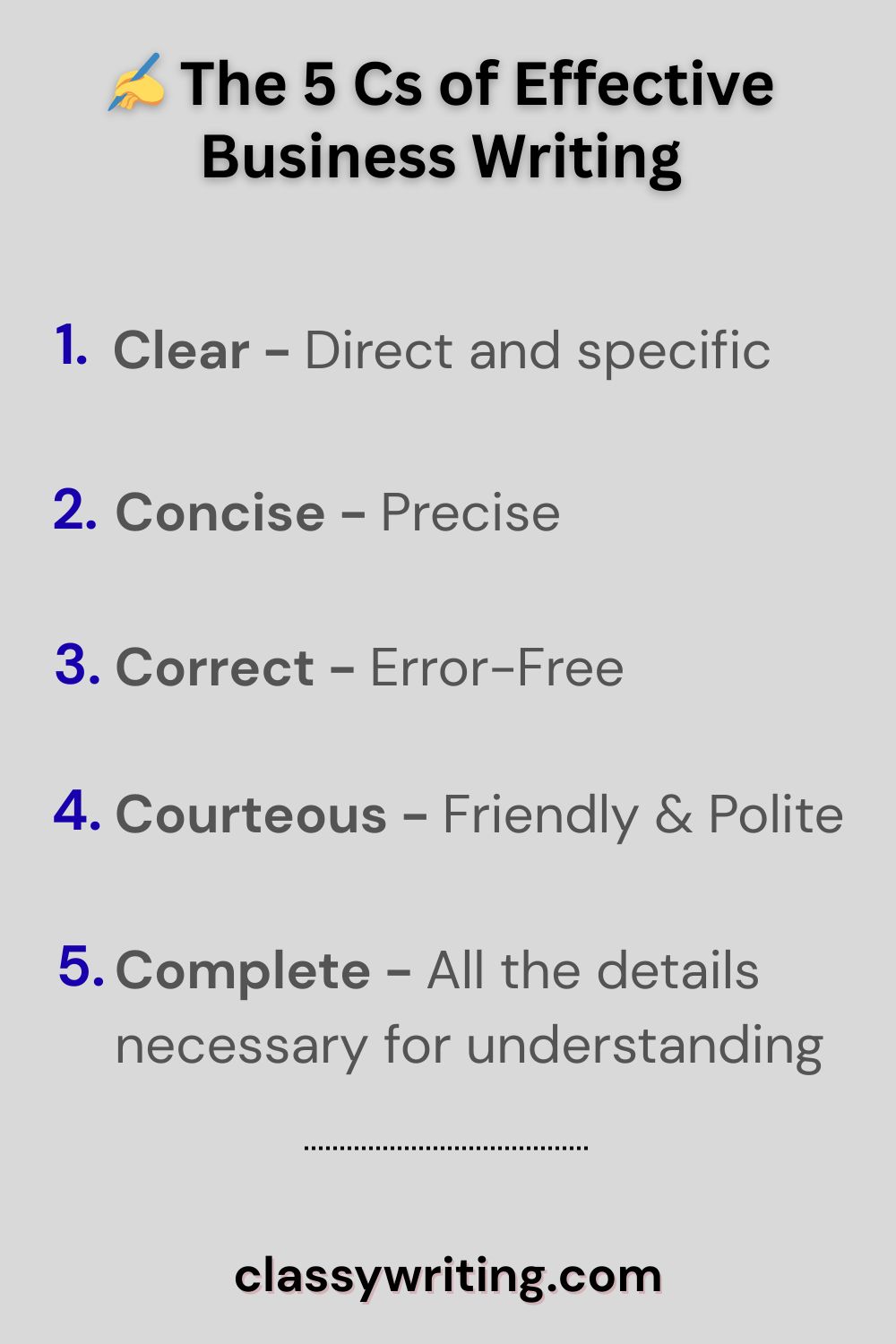
▪️ Have another set of eyes see it — preferably a friend or colleague with grammar skills you trust who will give constructive criticism. If no one else is available or you need more feedback, a professional like me can help.
▪️ Use AI, which can range from a simple grammar or spell-check in Microsoft Word or Grammarly to asking apps like Claude how to improve it. But remember: it’s called artificial intelligence for a reason. AI can spot a misplaced comma. But it won’t tell you your opening paragraph sounds like every other estate planning firm’s. A human can spot what makes YOU different and worth hiring. Always have a human comb through your copy.
Some common words and phrases:
▪️ Pompous (overly important sounding): Utilize, leverage, prioritize
▪️ Vague or unclear: maybe, I guess, perhaps, might
▪️ Create a separate web page for disclaimers to link back to from an e-newsletter or other marketing materials. On social media profiles or in e-newsletters, add a one or two-sentence disclaimer at the end.
▪️ Ensure your fine print isn’t too fine. For example, light gray text on a white background (low contrast) is unreadable for many. Check that it meets ADA (Americans with Disabilities Act) standards for contrast so you don’t ignore visually impaired readers.
▪️ Create a company style guide – It can help you or your employees clarify your wording, punctuation, and formatting. It may also set your design standards, from the logos and fonts to the colors you use. Update it regularly.
▪️ Enforce company communication policies – Use your guide to ensure all your messaging stays on brand. Stick to your talking points to maintain consistency.
Do regular content or messaging audits. Your communications policy may also outline crisis communication strategies for clear and concise business communication.
Clear copy draws leads who “get” you and weeds out those who don’t. Working with clients who value you and your work makes it more rewarding and meaningful.
Sharpen your image with quality custom content
How do you think clearly to write clearly? Feel free to comment below.
QUOTES
“Clarity is the most important characteristic of good business writing.”
Mignon Fogarty, Grammar Girl Quick and Dirty Tips for Better Writing
“Anyone who can think clearly can write clearly. But neither is easy.”
William Feather