
Many creators don’t follow a newsletter content strategy — the framework that supports regular publishing. The roadmap with clear directions (and easy exits). The hub that links every piece.
I couldn’t have kept publishing 5-Minute Business Writing Tips without one. In the beginning, I struggled to create content while I worked part-time. I usually offered five points on a writing topic in a fixed listicle format — like I do now, but think “Ultra Slim-Fast” edition.
2013 was the year Pope Benedict XVI resigned, making way for the Argentinian Pope Francis. Among other notable events, Prince William and Princess Kate welcomed their first son, Prince George, and Disney released the hit animated movie “Frozen.” That March, Xi Jinping became president of China.
That same month, I launched my first newsletter. Since then, as of this writing, I’ve published roughly 163 issues. I changed email service providers once or twice afterward, and can’t point to the first issue. Here’s a sample I gave out at networking events that spring. Like an ex-boyfriend, it looked good at the time. 🙂
Now in its early teens, I can’t say that this newsletter hasn’t experienced an identity crisis lately. There’s some truth to the idea that we’re turning to the robots to answer “how tos” rather than blogs.
Research, however, tells me that in some cases, people still search for in-depth answers on some topics and are also interested in a “how I” angle — the lived experience AI can’t offer.
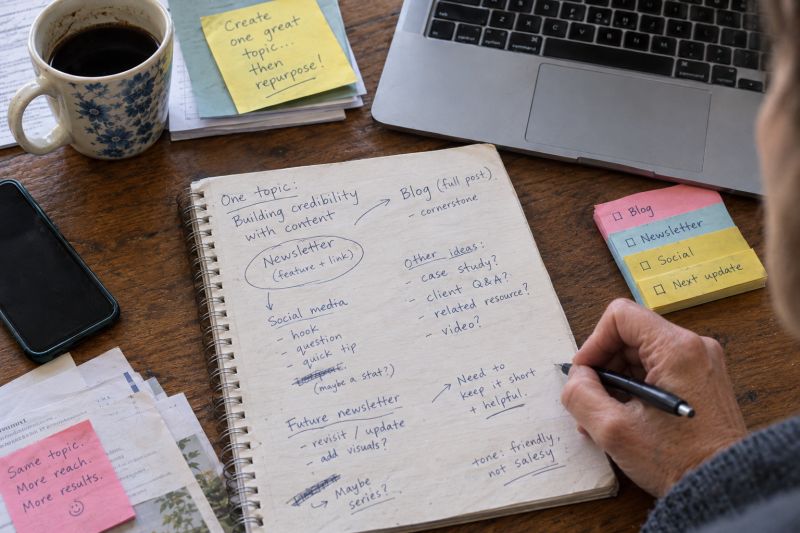
My newsletter has always played the starring role in my marketing. Ten years ago, when I converted my website to WordPress, it became more of a newsletter/blog and a focal point for a broader strategy. That single e-newsletter topic yields a blog, which then becomes a newsletter feature and a series of social media posts.
It’s not mere cutting and pasting — you reshape the content for each channel. If you have bigger plans, the possibilities stretch farther than you might expect.
| Channel | Role |
|---|---|
| Blog post | The searchable, full story |
| Newsletter | The personal note, fresh angle, takeaway, and link |
| Social post | A hook, question, or insight that teases the topic |
| Future newsletter | I revisit or update the original post |
Mike Kim calls it a “newsletter first” strategy. Mine is technically more “blog first,” because the newsletter features my latest blog. The newsletter and social posts are fleeting; the blog is the cornerstone.
The case for a focused strategy is building: among B2B marketers who said their content strategy improved results in the past year, 74 percent credited refining that strategy. For me, refinement meant deciding that one idea could do more than one job.
I’ve used the same approach with a long-term client, maintaining a steady publishing schedule without requiring a new topic for every channel.
Such a strategy not only keeps you going, it keeps the right clients finding you.
5 Newsletter Content Strategy Benefits Based on What I’ve Learned
1. It saves time on content creation and ideation. Automating the process, like with AI, can save more time. But that makes your content blend in. Adding your unique personality or flair (aka brand voice) takes time, yet the effort is more worthwhile for distinguishing who you are. You’ll also want to sprinkle in your knowledge and expertise, like research or insights you’ve gained.
2. It’s your platform. You may take your subscriber list anywhere. Much like a website, sitting directly in front of your audience gives you more control over who sees your writing. On social media and in search, algorithms make catching attention more of a gamble, much like investing in the companies themselves, both subject to their leaders’ whims.
3. Keeping it simple keeps you focused. Following a basic format, as I do with listicles, helps. But ease doesn’t mean effortless.
Yes, you worry less about creating, so you’re more likely to stick with a newsletter content strategy long-term. Though it feels like you must keep feeding a content Cookie Monster, think of your newsletter as a vehicle for sharing your expertise and building relationships.
And when life happens, it’s OK to step back. When I was slammed with work or busy caring for my mother, keeping up was tough. Even after she passed, I kept plugging away — because I felt I must get the next issue out on time.
Build a system simple enough to plan around, reuse content from, and return to without feeling like you’ve fallen behind (even if you have). When you’re busy, a minimum viable issue might be one helpful link, a brief update, or a thought-provoking question.
4. It builds trust. Publishing regularly — even when stuff happens — helps you meet your readers’ expectations. They know when they’ll get your newsletter and what they’ll get. That keeps them reading, and eventually, more likely to buy.
Building that relationship is something I help service providers do through consistent, well-crafted newsletters.
5. It builds relationships with readers — one word at a time — beyond numbers on a marketing dashboard. About 20 percent of my subscribers have been with me for five years or more. If you’re one of them, thank you for reading. And it’s always great when something you’ve written sparks a conversation.
An algorithm can’t take that direct line away from you. An established reader relationship also “pre-qualifies” customers so they know your values and approach before they decide to work with you.
The numbers can be important in gauging the quality of that relationship. Opens and clicks show which topics draw attention. Replies, repeat readers, and questions people ask tell you more about whether your content builds relationships.
Choose one or two business-relevant metrics and one human measure like reader replies to track over time.
| What you want content to do | Better signal to watch |
|---|---|
| Build an owned audience | Net subscriber growth and unsubscribe pattern over several months |
| Create engagement | Thoughtful replies, forwarded emails, clicks to an important resource |
| Bring in prospects | Consultation inquiries, discovery call mentions, referral sources |
| Build trust | Repeat readers, client comments, referrals, and returning visitors |
| Improve efficiency | Number of useful assets or conversations generated from one core topic |
The flip side of regular publishing is that it filters out the wrong clients (and readers). It’s a relationship built on permission. Someone who disagrees with your views or seeks different advice will likely unsubscribe. That’s not necessarily a loss. That’s how the email relationship process works.
But when they choose to stay, you have a chance to keep earning their attention.
Now that you know how one idea springboards a newsletter content strategy, how about getting started?
Explore how to make one idea do the work of five. Let’s build your newsletter strategy together.
If you’ve been reading this newsletter/blog for a while, I’d love to know: what keeps you coming back? Please leave a comment.
QUOTES
“People pay first with their attention. For us experts, this is an expensive acquisition. The fraction of those who keep paying attention will stay not because of what you know, but for how you think.”
~ Mike Kim, author, You Are the Brand
