5 Reasons to Make Your Newsletter the Heart of Your Content Strategy

Many creators don’t follow a newsletter content strategy — the framework that supports regular publishing. The roadmap with clear directions (and easy exits). The hub that links every piece.

I couldn’t have kept publishing 5-Minute Business Writing Tips without one. In the beginning, I struggled to create content while I worked part-time. I usually offered five points on a writing topic in a fixed listicle format — like I do now, but think “Ultra Slim-Fast” edition.
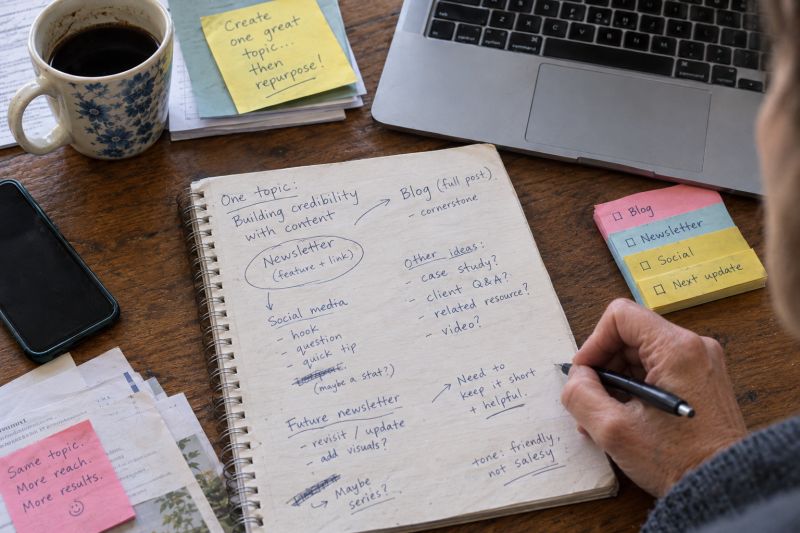
Someone at a desk surrounded by a coffee cup, a laptop, and Post-It Notes developing a newsletter content strategy in a notebook.

2013 was the year Pope Benedict XVI resigned, making way for the Argentinian Pope Francis. Among other notable events, Prince William and Princess Kate welcomed their first son, Prince George, and Disney released the hit animated movie “Frozen.” That March, Xi Jinping became president of China.

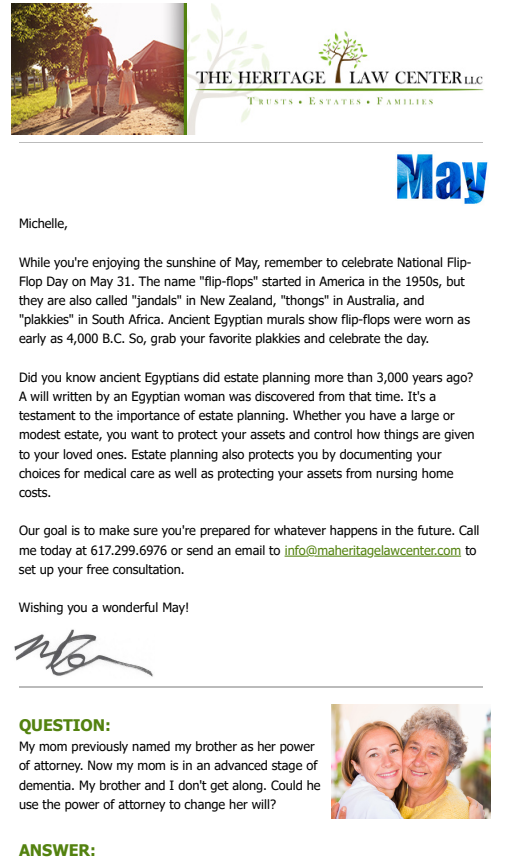
That same month, I launched my first newsletter. Since then, as of this writing, I’ve published roughly 163 issues. I changed email service providers once or twice afterward, and can’t point to the first issue. Here’s a sample I gave out at networking events that spring. Like an ex-boyfriend, it looked good at the time. 🙂

Now in its early teens, I can’t say that this newsletter hasn’t experienced an identity crisis lately. There’s some truth to the idea that we’re turning to the robots to answer “how tos” rather than blogs.

Research, however, tells me that in some cases, people still search for in-depth answers on some topics and are also interested in a “how I” angle — the lived experience AI can’t offer.

My newsletter has always played the starring role in my marketing. Ten years ago, when I converted my website to WordPress, it became more of a newsletter/blog and a focal point for a broader strategy. That single e-newsletter topic yields a blog, which then becomes a newsletter feature and a series of social media posts.

It’s not mere cutting and pasting — you reshape the content for each channel. If you have bigger plans, the possibilities stretch farther than you might expect.

ChannelRole
Blog postThe searchable, full story
NewsletterThe personal note, fresh angle, takeaway, and link
Social postA hook, question, or insight that teases the topic
Future newsletterI revisit or update the original post

Mike Kim calls it a “newsletter first” strategy. Mine is technically more “blog first,” because the newsletter features my latest blog. The newsletter and social posts are fleeting; the blog is the cornerstone.

The case for a focused strategy is building: among B2B marketers who said their content strategy improved results in the past year, 74 percent credited refining that strategy. For me, refinement meant deciding that one idea could do more than one job.

I’ve used the same approach with a long-term client, maintaining a steady publishing schedule without requiring a new topic for every channel.

Such a strategy not only keeps you going, it keeps the right clients finding you.

5 Newsletter Content Strategy Benefits Based on What I’ve Learned

1. It saves time on content creation and ideation. Automating the process, like with AI, can save more time. But that makes your content blend in. Adding your unique personality or flair (aka brand voice) takes time, yet the effort is more worthwhile for distinguishing who you are. You’ll also want to sprinkle in your knowledge and expertise, like research or insights you’ve gained.

2. It’s your platform. You may take your subscriber list anywhere. Much like a website, sitting directly in front of your audience gives you more control over who sees your writing. On social media and in search, algorithms make catching attention more of a gamble, much like investing in the companies themselves, both subject to their leaders’ whims.

3. Keeping it simple keeps you focused. Following a basic format, as I do with listicles, helps. But ease doesn’t mean effortless.

Yes, you worry less about creating, so you’re more likely to stick with a newsletter content strategy long-term. Though it feels like you must keep feeding a content Cookie Monster, think of your newsletter as a vehicle for sharing your expertise and building relationships.

And when life happens, it’s OK to step back. When I was slammed with work or busy caring for my mother, keeping up was tough. Even after she passed, I kept plugging away — because I felt I must get the next issue out on time.

Build a system simple enough to plan around, reuse content from, and return to without feeling like you’ve fallen behind (even if you have). When you’re busy, a minimum viable issue might be one helpful link, a brief update, or a thought-provoking question.

4. It builds trust. Publishing regularly — even when stuff happens — helps you meet your readers’ expectations. They know when they’ll get your newsletter and what they’ll get. That keeps them reading, and eventually, more likely to buy.

Building that relationship is something I help service providers do through consistent, well-crafted newsletters.

5. It builds relationships with readers — one word at a time — beyond numbers on a marketing dashboard. About 20 percent of my subscribers have been with me for five years or more. If you’re one of them, thank you for reading. And it’s always great when something you’ve written sparks a conversation.

An algorithm can’t take that direct line away from you. An established reader relationship also “pre-qualifies” customers so they know your values and approach before they decide to work with you.

The numbers can be important in gauging the quality of that relationship. Opens and clicks show which topics draw attention. Replies, repeat readers, and questions people ask tell you more about whether your content builds relationships.

Choose one or two business-relevant metrics and one human measure like reader replies to track over time.

What you want content to doBetter signal to watch
Build an owned audienceNet subscriber growth and unsubscribe pattern over several months
Create engagementThoughtful replies, forwarded emails, clicks to an important resource
Bring in prospectsConsultation inquiries, discovery call mentions, referral sources
Build trustRepeat readers, client comments, referrals, and returning visitors
Improve efficiencyNumber of useful assets or conversations generated from one core topic

The flip side of regular publishing is that it filters out the wrong clients (and readers). It’s a relationship built on permission. Someone who disagrees with your views or seeks different advice will likely unsubscribe. That’s not necessarily a loss. That’s how the email relationship process works.

But when they choose to stay, you have a chance to keep earning their attention.

If you’ve been reading this newsletter/blog for a while, I’d love to know: what keeps you coming back? Please leave a comment.

QUOTES

“People pay first with their attention. For us experts, this is an expensive acquisition. The fraction of those who keep paying attention will stay not because of what you know, but for how you think.”

~ Mike Kim, author, You Are the Brand

How Do You Write a Business Newsletter Template?

Creating a good business newsletter template that builds credibility and attracts clients shouldn’t feel like a never-ending battle. One day you might win with an appealing design, and the next you lose readers with bland content. Without a clear and consistent structure, readers can become confused and look elsewhere.

For ten years, I’ve used simple frameworks to keep e-newsletter subscribers loyal. Download the Easy 5-Step Business E-Newsletter Template to create business-boosting emails.

What is a Good Business Newsletter Format?

Business newsletter template formats vary in style based on your industry, audience, and your goals.

When you adapt your template to your content, your goals, and your audience’s needs, you can build relationships that lead to sales.

In my experience, a strong business newsletter format focuses on:

  • An engaging introduction or feature articles with clear calls to action that build interest in your content and offers.
  • A one or two-column format (or a mix of both) to enhance reading or skimming.
  • Compelling design elements like quality images, consistent branding, complementary colors, and easy-to-read text.

The right business newsletter templates create must-read messages.

Templates and Snippets

“Think of it like having a toolbox full of ready-to-use content pieces. We create templates for different sections like updates, client stories, or promotions. When it’s newsletter time, we just plug in the relevant info and voilà!”

Tommy Mello, CEO, A1 Garage Door Service

How Do You Create a Branded Email Template?

Online newsletters are easier to customize, analyze the results, and send at any time, often costing less than a print newsletter.

Good Business Email Templates

Compared to paid options, free business email templates have limits; your email marketing provider (ESP) might restrict the number of “sends” and subscribers on your plan.

Design-wise, look for templates with a clear, mobile-friendly, and easy-to-scan design. ESPs offer everything from basic business newsletter templates to industry-specific designs.

Good formats organize your content well and help your messages maintain a look and feel consistent with your brand.

Email templates have some downsides. Layouts that look plain or are common, used by other businesses, don’t stand out. Templates might also not offer enough customization or personalization options. To avoid these issues, pick templates that fit your brand, customize them, and use subscriber data to personalize the content as much as possible.

Test different layouts, content locations, CTAs, and subject lines. Making the design mobile-friendly and adding video, animated images, or interactive sections can encourage engagement. Personalizing the content for each reader also helps.

Tracking data to see what works best lets you adapt the design over time.

Your email footer should comply with anti-spam regulations like CAN-SPAM (U.S.), and GDPR (Europe).

An industry-specific one for professional services firms (accountants, attorneys, etc.), can yield an engaging email. A clear format is crucial, as is clear writing.

Email Marketing Resources:

Knowing how to write an article for a business newsletter can prepare you for writing a business newsletter. It’s all part of how to write an email promoting your business. Suitable writing styles also vary by industry. Learn how to create a professional email newsletter or how to write a law firm newsletter.

Successful Business Newsletters: Case Studies

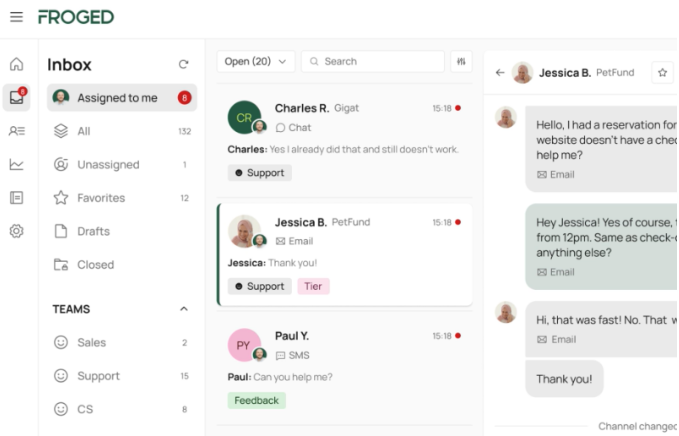
The FROGED software platform inbox, showing folders on the left, email senders in the middle, and text-filled balloons on the right. Their business newsletter templates followed a simple format.

Marketing Sherpa’s research offers insights into email marketing methods that have boosted engagement.

Their study of the software platform FROGED‘s emails showed the company’s switch to plain-text messages with simple calls to action doubled open and click-through rates.

It helped that the emails came from a staff member, adding a personal touch.

United Capital's FinLife Digest e-newsletter. A focus on interesting, trustworthy content made their business newsletter format stand out.

Their study of financial life management company United Capital showed how the firm revamped its “FinLife Digest” newsletter with original content and curated pieces.

This mix aimed to offer more valuable content. Their research showed readers cared about more than saving and investing, prompting United to add content on broader financial life stages. This customer-centric approach boosted newsletter engagement by 145% in one year.

Both newsletters used simple templates filled with interesting, trustworthy content.

Business Email Templates – Free Download

Even with a template, it’s not always clear where to place key e-newsletter content.

If you’re tired of wasting time guessing, get an outline that shows what to add and where for maximum engagement. Use it to fill your e-newsletters with information your audience will love.

The template suitable for any business covers:

  • 5 essential email elements
  • The most eye-catching places for engagement and action
  • Instructions for government-compliant footers
  • BONUS: customizable HTML templates for platforms like MailChimp

With this template, you can create a newsletter that “wows” your subscribers and keeps them engaged. And visual learners will easily spot where everything goes.

How Do You Update Your Business Template?

If you use an email service provider, updating your template should be as easy as a few clicks in your content boxes. Once you’ve saved it, email yourself a copy and see how it looks on your laptop, desktop, or mobile devices. Many platforms also let you preview it in different screen sizes.

Business E-Newsletter Template Creation Made Easy

With these tips, you can spend more time creating and less time guessing. Making a business newsletter template becomes as easy as 1-2-3.

To save time and stress less, get the Easy 5-Step Business E-Newsletter template.

What Are the Best Healthcare Newsletters? Examples

The best healthcare newsletter examples leave you wondering what’s in the next issue. The best way to create healthcare newsletters that convert is to see the world through your patients’ eyes.

🎁 Free Resource: Skip the guesswork. Get instant access to ready-to-use healthcare newsletter templates and start sending messages patients will open.

What is the Best Health Newsletter?

There’s no one “best” health newsletter. Two of the best healthcare newsletter examples include:

  • Loma Linda University Health (A Healthy Tomorrow): Best for patient-focused education, using staff expertise and eye-catching layouts to enhance their authority.
  • Parsley Health: Best for concise advice in a clean two-column format with clear calls to action.

For an analysis of what makes them leading newsletters, read on.

What Makes a Great Healthcare Newsletter?

A great healthcare newsletter must blend expert advice with engaging, easy-to-read content. According to industry standards, the best healthcare newsletters consistently:

  • Establish Trust: Feature advice from experienced medical staff, use reliable sources, and maintain HIPAA compliance.
  • Contain Clean Layouts: Use brand-appropriate visuals and contrasting background colors while avoiding clutter with competing calls-to-action.
  • Simplify Complex Ideas: Translate medical jargon and research into plain English patients can easily understand.

Healthcare Newsletter Examples

One of the best healthcare newsletter examples: Loma Linda University Health's email featuring the theme "Go Red for Heart Month."
  • Target audience: Loma Linda University Health patients
  • Content focus: Health maintenance and illness prevention
  • Expertise: Medical providers’ advice

This e-newsletter features a good example of a themed format; it promotes Heart Month with suitable shades of red throughout.

Its title, “A Healthy Tomorrow,” is one of the more inspiring healthcare newsletter names.

  • Headline hook: “5 Heart Numbers” plays on the psychological pull of odd numbers, which research suggests are more attention-getting than even ones.
  • Encouraging interaction: Links to a quiz and a related piece inspire responses.
  • Built-in credibility: Quotes from an on-staff cardiologist to build patient trust.
  • Stoking curiosity: The concise email subject line “Go Red for Heart Health.”
  • Holding attention: The alternating background colors in the featured items help them “pop” while they stay on theme.
  • Boost clicks: Place social media icons at the top.
  • Reduce confusion: The section below the third article features two calls to action (CTAs), side-by-side. One could be removed or moved to the top.
  • Cut clutter: Remove the unnecessary table of contents and reduce the image sizes, especially the top half of the header.
The Parsley Health e-newsletter on gut health, one of the best healthcare newsletters.
  • Target audience: Parsley Health patients
  • Content focus: gut health issues
  • Expertise: “Top doctors trained in root-cause resolution medicine.”

With its focus on better gut health, Parsley Health follows a consistent theme.

  • Concise content: From the clear email subject line repeated in the headline (“3 tips for gut health”) to the final CTA and anti-spam compliant footer.
  • Building engagement: The carefully placed images draw readers in, and the two-column format in the middle reduces scrolling.
  • Showing the benefits: Gentle persuasion through statements like “Parsley Health is here to help you understand and heal chronic digestive symptoms.” The tips, video, and copy below expand on the meaning, effectively addressing the buyer’s journey phases.
  • Boost clicks: Place the Instagram icon at the top, too.
  • Cut clutter: Fewer calls to action could improve reader focus.
In the healthcare industry, e-newsletters serve as both promotional material and a means of direct communication that delivers health updates, news, and educational content directly to patients’ mailboxes. This communication develops trust and loyalty that are critical in providing healthcare.”

Both newsletters subtly show expertise in ways that boost trust and credibility; they come across as reputable health organizations. The messages hold interest, though they could be shorter to keep readers engaged.

These healthcare email marketing examples target content to a specific audience: patients, especially those with chronic conditions. E-newsletters geared to caregivers or health professionals would advise on patient care.

The healthcare newsletter examples emphasize trust-building — the quality of care affects people’s lives.

How to foster accuracy and credibility in healthcare e-newsletters:

  • Feature advice from experienced staff
  • Show:
    • Awards won
    • HIPAA compliance
    • Reliable data sources

Maintaining trust in healthcare email marketing is hard because you must share helpful health details while you properly advertise without sharing private patient information.

Resources:

Healthcare newsletters are your direct line to patients, helping you deliver important information like policy changes and appointment reminders.

Knowing how to write a newsletter article can prepare you to write a business newsletter or create a professional email newsletter.

Healthcare Email Marketing Compliance and Regulations

Healthcare email marketing must follow data privacy rules like HIPAA, GDPR, CASL, and CAN-SPAM. Beyond HIPAA compliance, legal considerations include getting proper consent and offering email opt-in procedures.

HIPAA Requirements for Protected Health Information (PHI)

  • Patient authorization
  • Encryption
  • Business associate agreements
  • Easy unsubscribe instructions

GDPR Mandates

  • Processing personal data for marketing
  • Data protection principles
  • Letting patients exercise their data rights

CAN-SPAM: commercial emails must include unsubscribe options, accurate headers, ad identification, and a physical address.

Best Practices:

  • Get clear consent before sending commercial emails.
  • Segment communications to send commercial content only to opted-in recipients.
  • Use encryption and secure processes to protect data privacy and integrity.
  • Provide clear privacy notices, preference management, and easy opt-out options.
  • Maintain detailed documentation of data processing activities for compliance.
  • Ensure marketing emails have accurate headers, subject lines, ad labels, and a physical mailing address.
  • Honor opt-out requests in ten business days.

An attractive design and informative, trustworthy content make a healthcare newsletter readers won’t want to miss. Start by considering what your patients want to read and convey the information in a way that’s easy to digest.

Stop struggling with patient emails. The free Easy 5-Step Business E-Newsletter Template helps you draft engaging updates in minutes.

Instant PDF Download • 100% Free • No Credit Card Required

  • Originally published: June 12, 2024
  • Last updated: August 4, 2026

What Are the Elements of an Effective Business Newsletter?

An effective business newsletter contains a clear format, design, and writing. Yet many business promotion emails don’t follow this best practice, potentially losing sales.

With ten years of experience, I’ve used clear email content and a simple layout to enhance engagement. If you struggle to keep publishing, see my e-newsletter packages or get a free audit.

How Email Marketing Helps Business

  • Repeat advertising – Consistent e-newsletter marketing builds brand awareness, trust, and customer relationships. Per the Marketing Rule of 7, the average customer must see a message at least seven times before they will buy.
  • Cheap, competitive advertising: Compared to other marketing channels, it’s among the most affordable. A low-cost email campaign that yields sales can turn a profit.
  • Easy access to metrics: you may check open, click-through, or response rates quickly to measure your campaigns’ results.
  • Targeted and personalized messaging: segment your list by customer demographics, behavior, and interests. Emails with personalized subject lines are 26 percent more likely to be opened.”
  • Direct marketing: Automated email campaigns nurture existing leads through the sales funnel.
  • Brand loyalty: engaging content keeps readers interested in your offerings, helping you build long-term bonds with them. According to a March 2024 Constant Contact study, the average open rate across all industries is 38 percent. 

What is An Effective Business Email Marketing Strategy?


An effective business email marketing strategy includes strong visuals. A young woman in a suit looking at the screen of a large tablet PC showing graphs and charts.

Start by defining your email goals. Do you want to highlight your expertise? Showcase your products or services?

Aligning content to clients’ needs guides them through the sales funnel effectively. Address readers at all stages of the buyer’s journey. Offer educational material for those becoming aware and more in-depth information for readers exploring their options.

Elements of Effective Business Newsletters

  1. Subject Lines
  • Use clear, concise language
  • Add power words, numbers, scarcity, or other emotion-evoking methods to attract attention

Example: 5 Little-Known Tax Strategies for Small Businesses

  1. Structure
  1. Engaging Content

Example: Share a client success story highlighting your expertise

  1. Personalization

Segment your email list and customize content based on readers’ interests and behaviors.

“To make e-newsletters more appealing to readers, it is important to customize content based on customer preferences, past interactions with them, and their specific requirements. Similarly, you may want to segment your email lists so you can send targeted messages that resonate with different kinds of people within these industries.”

Keran Smith, co-founder and cMo, lyfe marketing
  1. Readability

Ensure accessibility by using descriptive alt-text, proper color contrast, and easy-to-read fonts.

A focused approach — for any business, regardless of the type or size — yields content that connects and inspires action.

What is An Effective Business Email Marketing Template?

The downsides of e-newsletter marketing include the perception that emails are spam and “list fatigue,” when subscribers lose interest in your messages. To minimize these issues, follow these best practices:

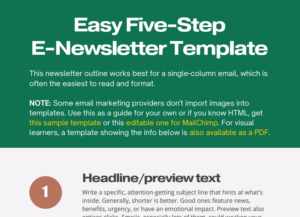
A partial view of the Easy Five-Step E-Newsletter Template.
  1. Quality: a layout should include mobile-friendly design and accessibility features. Responsive design automatically adapts the layout and content to fit any screen size, ensuring it’s readable on smartphones and tablets.
  2. Template Options:
    • Basic Layouts: Simple structures for easy content organization.
    • Industry-Specific: Imagery and layouts relevant to your field.
    • Multimedia: For videos and interactive content.
    • Curated Content: Information culled from various sources.
    • Product/Service Showcase: Highlight products, services, and special offers.
    • Event Promotion: Designed for upcoming promotions.

3. Text and Visuals: Put the most important information at the top to maximize engagement.

4. Legally-Compliant Footers: Anti-spam laws like CAN-SPAM (U.S.) and GDPR (Europe) ensure responsible email marketing.

Resources:

Many email marketing platforms offer customizable templates for professional, attractive, and on-brand newsletters.

What is a Sample Business Newsletter?

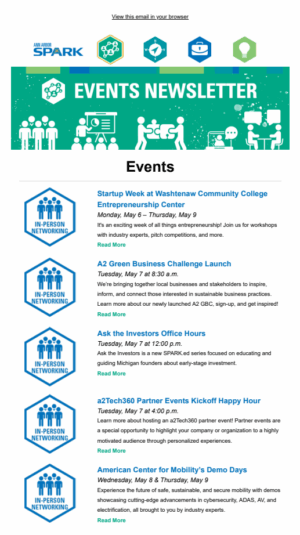
The Ann Arbor SPARK (AAS) e-newsletter follows many of these best practices:

  1. Compelling Headline: Entice readers to open the email.

Instead of their usual headline, “Check out these upcoming events in Ann Arbor!,” AAS could feature an event or a common theme.

Example: 14 Must-Do May Events in the Ann Arbor Area

It copies the headline of one of the feature articles (only cutting and pasting is required 🌝).

  1. An Engaging Content Structure: A clear and concise layout with informative, audience-focused information (e.g., news, testimonials, CTAs).


Among the newsletter examples for business: The Ann Arbor SPARK e-newsletter features a clear layout coupled with eye-catching design and content.

The clear format, with colorful headings and images separating the events from the features, ignites interest. The events section could be organized into two columns by date to reduce scrolling.

  1. Visual Appeal: Quality images, consistent branding, and readable fonts foster engagement.

The AAS e-newsletter engages well. But larger heading text, descriptive alt-text for images, and more instructive CTAs (beyond “Read More”) could enhance accessibility and interest. The CTA “lead in” text, however, emphasizes the benefits readers can expect well.

The AAS e-newsletter is one of the best newsletter examples for business. It effectively merges a clear layout with impactful visuals to form a must-read message.

Effortless Business E-Newsletter Creation

Making a newsletter without proper tools is like baking a cake from scratch — it’s time-consuming. With the elements of an effective business newsletter, you can create your own faster.

If you’re unsure where to start or lack time, explore my e-newsletter packages or get a free audit.