What Are the Best Healthcare Newsletters? Examples

The best healthcare newsletter examples leave you wondering what’s in the next issue. The best way to create healthcare newsletters that convert is to see the world through your patients’ eyes.
🎁 Free Resource: Skip the guesswork. Get instant access to ready-to-use healthcare newsletter templates and start sending messages patients will open.
What is the Best Health Newsletter?
There’s no one “best” health newsletter. Two of the best healthcare newsletter examples include:
- Loma Linda University Health (A Healthy Tomorrow): Best for patient-focused education, using staff expertise and eye-catching layouts to enhance their authority.
- Parsley Health: Best for concise advice in a clean two-column format with clear calls to action.
For an analysis of what makes them leading newsletters, read on.
What Makes a Great Healthcare Newsletter?
A great healthcare newsletter must blend expert advice with engaging, easy-to-read content. According to industry standards, the best healthcare newsletters consistently:
- Establish Trust: Feature advice from experienced medical staff, use reliable sources, and maintain HIPAA compliance.
- Contain Clean Layouts: Use brand-appropriate visuals and contrasting background colors while avoiding clutter with competing calls-to-action.
- Simplify Complex Ideas: Translate medical jargon and research into plain English patients can easily understand.
Healthcare Newsletter Examples

A Healthy Tomorrow
- Target audience: Loma Linda University Health patients
- Content focus: Health maintenance and illness prevention
- Expertise: Medical providers’ advice
This e-newsletter features a good example of a themed format; it promotes Heart Month with suitable shades of red throughout.
Its title, “A Healthy Tomorrow,” is one of the more inspiring healthcare newsletter names.
Done Well
- Headline hook: “5 Heart Numbers” plays on the psychological pull of odd numbers, which research suggests are more attention-getting than even ones.
- Encouraging interaction: Links to a quiz and a related piece inspire responses.
- Built-in credibility: Quotes from an on-staff cardiologist to build patient trust.
- Stoking curiosity: The concise email subject line “Go Red for Heart Health.”
- Holding attention: The alternating background colors in the featured items help them “pop” while they stay on theme.
Do Better
- Boost clicks: Place social media icons at the top.
- Reduce confusion: The section below the third article features two calls to action (CTAs), side-by-side. One could be removed or moved to the top.
- Cut clutter: Remove the unnecessary table of contents and reduce the image sizes, especially the top half of the header.

Parsley Health
- Target audience: Parsley Health patients
- Content focus: gut health issues
- Expertise: “Top doctors trained in root-cause resolution medicine.”
With its focus on better gut health, Parsley Health follows a consistent theme.
Done Well
- Concise content: From the clear email subject line repeated in the headline (“3 tips for gut health”) to the final CTA and anti-spam compliant footer.
- Building engagement: The carefully placed images draw readers in, and the two-column format in the middle reduces scrolling.
- Showing the benefits: Gentle persuasion through statements like “Parsley Health is here to help you understand and heal chronic digestive symptoms.” The tips, video, and copy below expand on the meaning, effectively addressing the buyer’s journey phases.
Do Better
- Boost clicks: Place the Instagram icon at the top, too.
- Cut clutter: Fewer calls to action could improve reader focus.
In the healthcare industry, e-newsletters serve as both promotional material and a means of direct communication that delivers health updates, news, and educational content directly to patients’ mailboxes. This communication develops trust and loyalty that are critical in providing healthcare.”
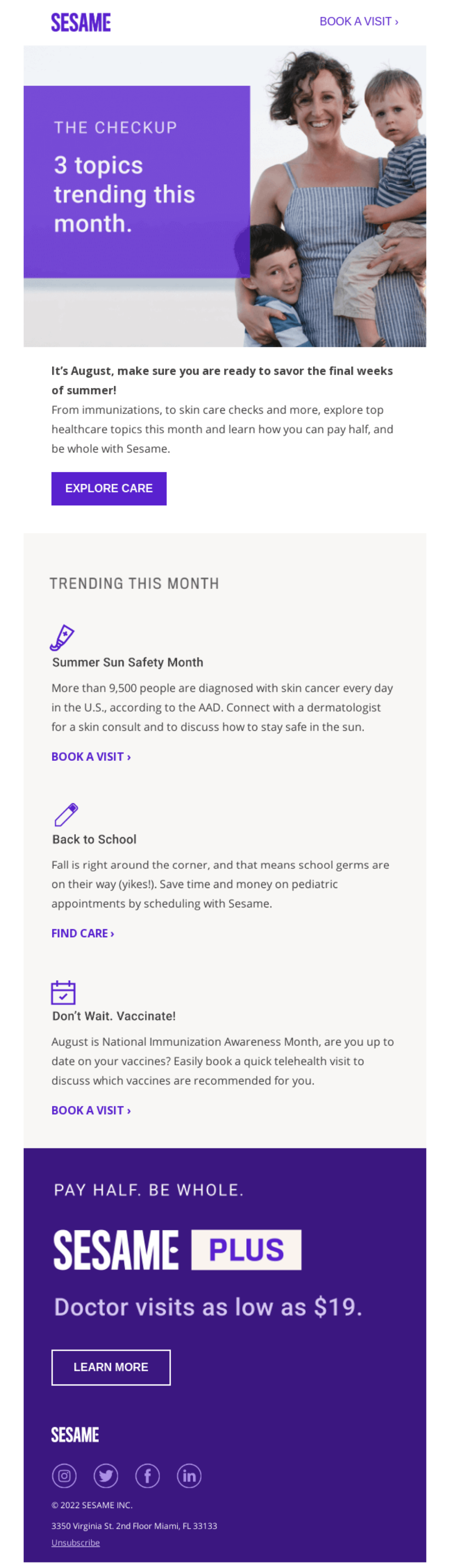
Both newsletters subtly show expertise in ways that boost trust and credibility; they come across as reputable health organizations. The messages hold interest, though they could be shorter to keep readers engaged.
These healthcare email marketing examples target content to a specific audience: patients, especially those with chronic conditions. E-newsletters geared to caregivers or health professionals would advise on patient care.
The healthcare newsletter examples emphasize trust-building — the quality of care affects people’s lives.
How to foster accuracy and credibility in healthcare e-newsletters:
- Feature advice from experienced staff
- Show:
- Awards won
- HIPAA compliance
- Reliable data sources
Maintaining trust in healthcare email marketing is hard because you must share helpful health details while you properly advertise without sharing private patient information.
Resources:
- HIPAA-Compliant Email Newsletters: Tips and Best Practices
- Healthcare Email Marketing: Tips on Strategy and HIPAA Compliance
Healthcare newsletters are your direct line to patients, helping you deliver important information like policy changes and appointment reminders.
Knowing how to write a newsletter article can prepare you to write a business newsletter or create a professional email newsletter.
Healthcare Email Marketing Compliance and Regulations
Healthcare email marketing must follow data privacy rules like HIPAA, GDPR, CASL, and CAN-SPAM. Beyond HIPAA compliance, legal considerations include getting proper consent and offering email opt-in procedures.
Regulations
HIPAA Requirements for Protected Health Information (PHI)
- Patient authorization
- Encryption
- Business associate agreements
- Easy unsubscribe instructions
GDPR Mandates
- Processing personal data for marketing
- Data protection principles
- Letting patients exercise their data rights
CAN-SPAM: commercial emails must include unsubscribe options, accurate headers, ad identification, and a physical address.
Best Practices:
- Get clear consent before sending commercial emails.
- Segment communications to send commercial content only to opted-in recipients.
- Use encryption and secure processes to protect data privacy and integrity.
- Provide clear privacy notices, preference management, and easy opt-out options.
- Maintain detailed documentation of data processing activities for compliance.
- Ensure marketing emails have accurate headers, subject lines, ad labels, and a physical mailing address.
- Honor opt-out requests in ten business days.
Crafting Interesting Healthcare Newsletter Examples
An attractive design and informative, trustworthy content make a healthcare newsletter readers won’t want to miss. Start by considering what your patients want to read and convey the information in a way that’s easy to digest.
Stop struggling with patient emails. The free Easy 5-Step Business E-Newsletter Template helps you draft engaging updates in minutes.
Instant PDF Download • 100% Free • No Credit Card Required
- Originally published: June 12, 2024
- Last updated: August 4, 2026