5 Ways to Write With Style

A little creative flair helps everyone write with style and hook readers. With the rise of generative AI, because it’s trained on others’ online content, bland or ordinary writing abounds. AI-created copy also promotes common writing woes, from clichés to the passive voice.

Learn more about each of the steps listed here in this series of five videos.

Here’s how to sell a product, a service, or an idea memorably to gain leads.

1. Evoke imagery – Writers have often been advised to “show, not tell”: to choose words that stimulate the five senses. “To be” verbs and other weak wording advise readers how to feel or think. Such passages are as exciting as endless vacation photos.

  • Example: The storm was terrifying.
  • Rewrite: The wind roared like a train, causing the hairs on the back of Jan’s neck to rise.

The latter shows the physical effects of the wind on Jan through the senses of feeling and hearing. Descriptive language adds impact to your storytelling, headlines, and body copy.

Poets excel at turning the literal into the figurative.

Example: “The fog comes on little cat feet.” ~ Carl Sandburg, Fog

Studying this art form can inspire creative wording. It can truly enhance your storytelling. In business terms, it can mean translating ordinary descriptions of a service into images everyone can relate to.

Example: “Like a good neighbor, State Farm is there.”

To enhance imagery, imagine a scene unfolding in your mind and describe it with action verbs, adjectives, or other details. In advertising, choose power words

For promotional purposes, descriptive writing reframes concepts or terms to make them sound more appealing. It prefers adjectives like “oven-crisp,” to “baked.” As Roger Dooley noted in “Brainfluence,” it doesn’t work in contexts that require a clear understanding of information, such as ordering instructions.

2. Add rhythm – Vary the length of your sentences. For instance, three short ones in a row sound robotic:

A man dressed as a female punk wearing an bright orange wig, green eyeshadow, and dark lipstick writing with a pencil on a pad of paper.

As they flow from one idea to the next, a mix of short and long sentences adds rhythm and engrosses readers.

When you repeat words for emphasis, you can produce a memorable statement. Leaders like Ronald Reagan and Martin Luther King, Jr. used this anaphora effectively to highlight their beliefs and ideas. They tied them together clearly while they evoked strong emotions in their listeners. 

Example: “Ask not what your country can do for you, ask what you can do for your country.” ~ John F. Kennedy

Anaphora also works well in ads. 

Example: “Big skies. Big scenery. Big possibilities for all kinds of adventure.” (WestJet)

Rhythm, coupled with the tone behind your words, adds grace or eloquence.

Alliteration, words that start with the same letter or sound nearby in a sentence, acts like music to readers’ ears.

Like anaphora, it makes passages “stickier,” adds emphasis, and stirs feelings. It also works well in slogans:

Example: Faster, fulfilling, and flexible business solutions.

Don’t veer into creating tongue twisters, though. Use similar-sounding words sparingly.

Example: You can’t cut corners.

3. Rhyme time – You don’t have to mimic Dr. Seuss — which can be a little “suss” to some — but similar-sounding words can also connect with readers.

According to cognitive fluency researcher Matt McGlone, rhyming phrases can feel more truthful or accurate to readers. They’re also easier for our brains to process, making them clearer and more memorable.

Rhyme can be most effective for boosting brand awareness and engagement in slogans, calls-to-action, or headlines.

Example: Plop, plop, fizz fizz, oh, what a relief it is! (Alka-Seltzer)

As shown, one word that rhymes with another is appealing. A one-syllable word also sounds natural.

Plays on words, however, can go over some readers’ heads. Prefer clear over clever phrasing.

4. Get creative – Clichés are overused passages that lack originality. 

Example: Think outside the box.

Consider other ways to say it with style. 

Revised: Find a new solution.

Cliché Finder can help you spotlight them in your work.

Behavioral marketing experts like Nancy Harhut have suggested that metaphors can transform abstract products into concrete or tangible ones. They help us grasp a concept quickly.

Example: “Crazy Egg is like a pair of X-ray glasses that lets you see exactly what people are doing on your website.”

5. Sound like yourself When I chose the phrase “write with style” as part of this blog’s title, I hadn’t read the International Paper ad by novelist Kurt Vonnegut. While I researched and wrote this piece, I stumbled across the ad, which is essentially an article featuring his tips on the topic. 

In it, Vonnegut advised against writing “like cultivated Englishmen of a century or more ago.” He also suggested you write like you speak and “say what you mean to say,” in easy-to-understand language. When you’re selling a product or a service, that can mean writing like your audience speaks.

Like Vonnegut’s works, his thoughts remain timeless. Our voices, perspectives, and experiences make us unique. ChatGPT hasn’t played darts. It hasn’t stubbed a toe or eaten creme brulee. Though it can create based on data, it lacks our perceptions. It doesn’t always duplicate humanity.

Discover how to write with style to reach clients who value and respect you and your business

How do you write with style? Feel free to comment below.

QUOTES

“If you scribble your thoughts any which way, your readers will surely feel that you care nothing about them. They will mark you down as an egomaniac or a chowderhead — or, worse, they will stop reading you.”

Kurt Vonnegut

5 Ways to Boost Your Writing Style and Tone for Business

1. Know the purpose of your document. Let it determine the appropriate writing style and tone.

  • Emails: People often write them like they speak, with relaxed language, using contractions and slang (“Let’s talk soon.”). Depending on company culture, internal memos may use more formal wording, forgoing humor and emojis. It may use neutral pronouns to remove potential bias.
  • Articles, web pages, newsletters, social media, and blog posts: Those that inform can include more neutral wording than those that entertain. If you want to interest people in buying a product or a service or to support something, you may use persuasive wording with psychological triggers, like emails warning of a sale that will end soon.
  • Crisis communications: When an emergency strikes on a mass scale, consider the gravity of the situation. Serious topics, such as widespread layoffs, a mass killing, or a harmful virus need care and sensitivity. Depending on the circumstances, it’s more empathetic to deliver the news by phone, video, or in person.

2. Simplify. Large blocks of text can be hard to read online, especially without proper formatting. Shorter words, sentences, and paragraphs free of jargon are easier to read. Add a list or bullet points to reduce blocks of text to improve scannability. Write in an active, rather than a passive voice, which fosters complex words and phrases.

3. Clarify. Explain complex concepts. Use examples. Add links to boost comprehension and save words. Insert images if they will enhance your explanation.

4. Show empathy, respect, and sincerity. Think about who your reader is, where they’re at, and what they struggle with.

  • End your email with a greeting.
  • Use the words “please” and “thank you” as appropriate.
  • Consider writing for inclusivity: different races, ethnicities, and people with disabilities.
  • Consider how readers from another culture may interpret your message.

5. Proofread. As a Forbes article declared, typos, especially lots of them, can make you look sloppy or “kill your brand.” Spell-checking software maker Grammarly reported in their study of 100 LinkedIn profiles of native English speakers that it can affect a professional’s ability to be promoted. They found that the profiles of people who weren’t promoted to a director-level position in the first ten years of their careers had 2.5 more errors than those who advanced.

Need to improve the tone or other parts of your writing to boost your image and your success? Consider a business writing coaching session.

BOOK A COACHING SESSION

What kind of tone works for you in your writing? Feel free to comment below.

Quotes

“Don’t you type at me in that tone of voice.” ~ Anonymous

“A writer doesn’t have a soundtrack or a strobe light to build the effect she wants. She has conflict, surprise, imagery, details, the words she chooses, and the way she arranges them in sentences.” ~ Adair Lara

5 Ways to Hook Readers With Your Subheadings

1. Move from the general to the specific. As one whiskey maker put it, “Don’t be vague — ask for Haig.”

Example: Scenarios for Changing Trusts
Revised: How to Divide Trust Assets Fairly

Another way to clarify your subheadings (and improve SEO) is to use questions people ask from Google’s Instant or Answer box or Answer the Public.

Example: When Should You Decant a Trust?

Several subheadings in a long article can form a table of contents.

2. Keep count – In a study of 100 million article headlines by digital marketing experts BuzzSumo, the top two most engaging headlines began with a number.

Example: 7 Ways NOT to Win an Argument

Numbers in headings can also help your SEO. For instance, many top-ranked pages have numbers in the titles and subheadings. They’re timeless attention-getters in ads and on magazine covers.

3. Add benefits – Think of subheadings as part of the content that helps promote your piece throughout. Feature a different benefit in each subsection.

Example: Sharpening Your Subheads to Build Engagement

4. Get active – Through action verbs and persuasive wording, subheads can lead into a call-to-action.

Example: “Listen to music ad-free and offline, free until December 6, 2022. Cancel anytime.” (Spotify)

5. Use moderation – Explain, but not too much. Leave some mystery with simplicity.

Example: How Sears Keeps its Promise


Interested in repurposing or re-posting your existing content? Consider a makeover to help increase impressions.

BOOST YOUR ENGAGEMENT


How have you used subheadings effectively? Feel free to comment further below.


Quotes

“Subheadings are like signposts for your readers.” ~ Cinden Lester

“Write subheads that reveal, rather than conceal, your contents.” ~ Ann Wylie, Wylie Communications


Comments? Suggestions? Need help with your communications? Contact me.

5 Steps to Personalized Content Made Easy

Personalized content feels like it was written just for your reader — because it was. Whether it’s a blog, an email, or a headline, these five steps help you craft copy that starts a conversation.

1. Speak to your reader – When you share your experiences, the pronoun “I” helps you connect with your audience.

But in marketing, the age-old, yet effective advice still holds: focus on your reader. Write less about yourself and more about their challenges. Use “you,” “your,” and sometimes “me” (from their perspective) to make the message more personal. Don’t just name them — speak to them

Example: Tell Me More About 24/7 Financial Planning

2. Write naturally – Unless you’re writing to others in your industry, resist any urges to lapse into jargon or pompous-sounding “big” words. Formal writing has its place. But stiff sentences and buzzword soup? Readers tune out fast.

Two older women, dressed in white shirts and wearing glasses, share a moment of connection as they read a greeting card together. The card evokes the essence of personalized content, fostering a sense of closeness and shared experience.

Read your writing aloud or use a voice-to-text app to capture a more natural tone. Make your reader feel like they’re talking to a friend or a client they trust, without losing them in a corporate memo.

Example: Berkshire Hathaway 2024 letter to shareholders

Warren Buffett’s annual letters to Berkshire Hathaway shareholders are famous for their authentic, down-to-earth tone, free of dry financial jargon. He explains investing concepts like he’s chatting with a friend over coffee.

"This letter comes to you as part of Berkshire’s annual report. As a public company, we are required to periodically tell you many specific facts and figures.

'Report,' however, implies a greater responsibility. In addition to the mandated data, we believe we owe you additional commentary about what you own and how we think. Our goal is to communicate with you in a manner that we would wish you to use if our positions were reversed – that is, if you were Berkshire’s CEO while I and my family were passive investors, trusting you with our savings."

It contrasts sharply with one from former energy company Enron, written in 2000:

"Our retail energy business achieved its highest level ever of total contract value. Our newest business, broadband services, significantly accelerated transaction activity, and our oldest business, the interstate pipelines, registered increased earnings…"

The jargon and references to Enron’s complex monetary structures later contributed to challenges in understanding the company’s true financial health.

3. Show your personality – When appropriate, whether your tone is witty, warm, or no-nonsense, let it shine. After all, you are your brand. You don’t have to give too much information, but sharing your stance can help your business or organization stand out.

Example:

❌ Welcome to our blog, where we share industry insights.
✅ Let’s discuss what works (and what doesn’t work) in content marketing.

4. Hyper-personalize smartly – Customize content and SEO strategies based on users’ behavior to boost engagement and rankings.

Examples:

  • SEO: Use location-based keywords (e.g., Best financial planners in [Your City]) to attract local searches and the right audience.
  • Website copy: Personalize homepage headlines based on users’ past interactions. Show returning visitors tailored headlines based on their prior browsing behavior. Highlight products they viewed or content categories they engaged with.
  • Emails: Add dynamic content, like product recommendations based on purchase history or past clicks.

5. Be yourself – Swipe files, AI, or templates can save time and inspire you. Use your unique words, examples, and experiences, which are more distinct and personal, to keep your audience tuned in.

Example:

❌ Dear Valued Customer, here’s our weekly update.
✅ Hey [First Name], our comfy hand-knit sweaters are just your size!

Real personalized content marketing goes beyond a “first name” basis. It’s in the details that say, “I see you,” the reference only they’d get, or the phrasing that sounds like them — because you did your homework to make it feel that way.

What does personalized content look like to you? Feel free to comment below.

Learn how to create content that connects with clients who value and respect you and your business

Quotes

“Actually talk to your customers. Use the language that they use. Talk about the things they talk about. Never feed salad to a lion.” ~ Jay Acunzo

“If you can take your personality and inject it into the message you share, you’ll be one step ahead in the content marketing game.” ~ Jason Miller

5 Checks for Trustworthy Website Content

How do you check if a website is trustworthy? The answer can make the difference between prospects who contact you or click away. Because trust is more than a feeling.

You might want to revisit your site to to improve key parts to send the right trust signals: signs visitors look for before they contact you or decide to buy. Use this checklist as your guide to what to consider and why it matters. Then try some of the steps and see how your site converts visitors into leads.

How to Know if a Website Content is Trustworthy

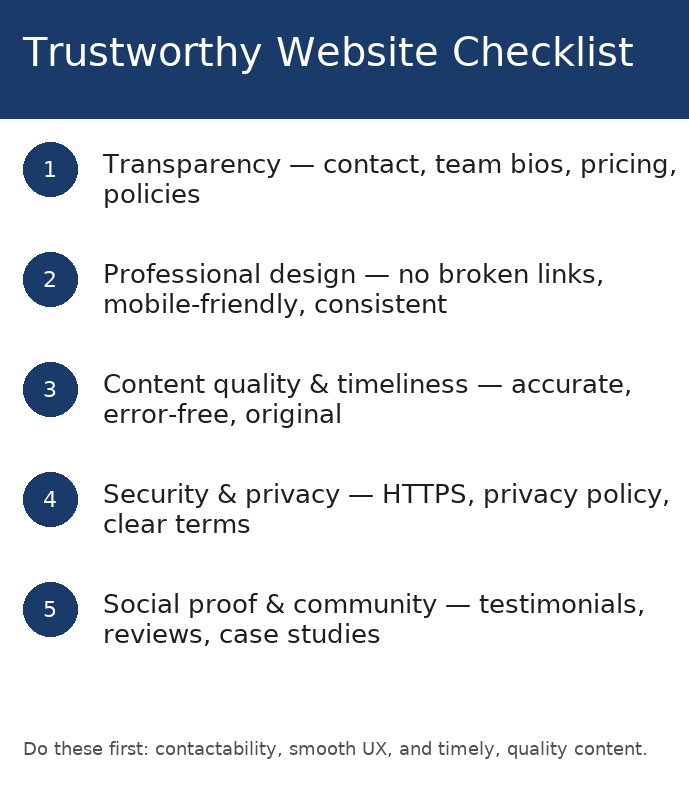
1. Transparency – A Huff Industrial Marketing report reveals visitors want more details about a company or organization, like:

  • Contact info
  • An “about” page with team bios
  • Pricing
  • Taxes or shipping fees

These all boost the chances of a sale. You can offer just enough information to satisfy curiosity.

Pricing: “Should I show prices or keep them private?” is a question service providers ask, fearing transparency could derail sales or that they’re limiting their income options. But the opposite might be true: being upfront helps you weed out the wrong customers — those who can’t afford you.

A hand marking a checklist with a black pen — a concept for a trustworthy website check to ensure quality and credibility factors are met.

A way around price-based objections is to show a starting price or a fee range. Adding what’s included in the pricing emphasizes the value customers get for their money.

Example: Our estate plans range from $1,200 (a simple will) to $4,500 (a will or trust, power of attorney, living will), depending on the complexity. For a custom estimate, contact us.

Contact info: A clear identity shows you have nothing to hide — and that you stand behind your expertise. If a visitor isn’t sure who’s behind a website or how to contact them, they’re more likely to look elsewhere. Have an easily accessible “About” page, physical address, phone number, and an email.

Service providers can waffle over whether to offer just a phone number or a contact form. To cover all the bases, show both, along with hours of operation or scheduling options that are easy to spot. If applicable, show directions and a map.

Example: Add your phone number as a clickable link and a “Book a 15-minute consult” button in the web page header and sticky footer with an hours block.

Offer a sample of deliverables, the onboarding process, or project scope: Lack of time, a fear of potential legal hassles, or of oversharing are among the reasons providers leave this out.

Something as simple as a “what’s included” or “what to expect” table under each product or service, or a link to a file clarify an offer. It removes friction, easing the buying process. Buyers know what they’ll get, must do, or how long it will take.

Example:

How A+ Accounting works in 3 steps:

  1. Intake and documents (week 1): 30-minute call + send paperwork.
  2. Complete and review (week 2): We send you the complete drafts; you review.
  3. Finalize, pay, and file (week 3): You pay, sign, and we file for you.

State your support terms, guarantee, or refund policy: Companies can avoid offering guarantees and similar assurances because they might have to honor them. But they reduce customers’ perceived buying risks, including the cost and commitment involved — and show your dedication to providing quality work.

Example: If we don’t meet deliverables in 30 days, we’ll [fix/credit/refund X%]. See terms. (Link to short policy.)

Questions to ask for a trustworthy website check:

  • Can I tell who is behind this website?
  • Is there a physical address, phone number, and an email listed?
  • Do potential customers know the value they’ll receive for their money?
  • Do they know what to expect if they buy from me?
  • Have I given visitors enough information to reduce their risks (or objections to) buying from/working with me?

2. Professional Design – When you visit pages that load in minutes or feel lost while internet surfing, you know how frustrating that is for visitors. Other issues, like broken links, outdated information, or technical errors make a site seem abandoned or unreliable.

Questions to ask:

  • Does my website look professional, or does it look like it was patched together?
  • Are there broken links or confusing menus?
  • Is the website easy to use on my mobile device?
  • Is the design consistent?

3. Content Quality and Timeliness – The Nielsen Norman Group (NNG) reports that a trustworthy website has error-free copy. “Fuzzy” facts and spelling, punctuation, and grammatical mistakes can make your business or organization look sloppy. But quality, up-to-date, and accurate information helps your site stand out. It shouldn’t rehash content available elsewhere.

Jargon: The Huff study also states website copy should be free of industry-specific terms (unless your target market uses them). If it’s not clear and easy to understand, it can confuse readers and increase their fear of buying.

Example:

Estate planning your way. What to expect:

  • A one-hour planning call + checklist
  • A drafted will or trust document (1–2 revisions)
  • A signed plan delivered and stored securely
A checklist of five elements for a trustworthy website check including transparency, professional design, content quality, security, and social proof.

Timeliness: Both studies reveal trustworthy website copy should be current.

Show your expertise: Visitors want to know who they’re working with and their level of experience. Offer author bios with titles and credentials and link to professional profiles. Photos and personal touches such as likes or dislikes build trust and reliability.

Example: Jane Smith, Partner — 14 years’ handling elder law and estates. Admitted: NY (2011). Published in State Bar Journal. [LinkedIn] [Full bio]

Reveal your sources: Businesses sometimes don’t disclose sources for claims due to the work involved and potential data privacy concerns. Articles should be well-researched, accurate, and answer customers’ questions. Reference claims through naming and linking to sources, press coverage, or show screenshots of data.

U.S. Federal Trade Commission rules require that advertising claims be truthful, non-deceptive, and evidence-based.

Questions to ask:

  • Is the information on my website accurate?
  • Is the content outdated? (e.g., copyright year, last blog post)
  • Are there lots of spelling and grammar mistakes?
  • Does the content seem original, or is it generic and copied from elsewhere?
  • What are the content writer’s qualifications?
  • Is the information cited from credible sources?
  • Does the author or organization have a clear bias?

4. Security and Privacy – Visitors need to feel that their personal and financial information is safe, especially on e-commerce sites. A secure connection and clearly displayed privacy policies and terms of service protect user data and build confidence.

Businesses can find this to be too technical and emphasize the website’s look and feel, but trust and security signals, including for accessibility, show you’re up-to-date with industry best practices.

Questions to ask:

  • Is my website secure? (e.g., does the URL start with “https://”)
  • Is there a privacy policy that clearly explains how visitor data will be used?
  • Does the site have any security badges or certifications?

5. Social Proof and Community – People often look to others to validate a website’s credibility. Highlight testimonials, client lists, customer reviews, and other third-party verifications (like industry awards or mentions in reputable media).

Businesses don’t show credentials or mentions because getting permission takes time, yet outside endorsements carry more weight.

Example: “As seen in / partners / press” with direct links.

Testimonials: How many do you need — and where should they go? When customers make decisions, quality beats quantity. Three to five short quotes can be convincing.

Reviews: Businesses often prefer to hide any negativity. But an honest display of reviews, including mistakes, can enhance your credibility. Your response to problems — whether you try to resolve them or remain silent — shows how you work with customers and affects your image.

Example: We post and respond to reviews — here’s an example and how we resolved a customer’s problem.

Case studies: They can be time-consuming and require permission from the people you feature. But real numbers and concrete — rather than generic outcomes — outside of promises — can convince visitors your products or services are effective.

If you must do so, keep client names confidential. Sharing metrics like A/B test results can reveal competitive tactics or client agreements.

Example:

  • Case snapshot: Estate cleanup
  • Problem: Client faced probate delays and missed filings.
  • Action: Reorganized estate plan and filed petitions; coordinated with trustee.
  • Result: Case closed in 5 months vs typical 10+ months; client reported reduced legal costs. [Read more / download PDF]

Questions to ask:

  • Does my website have testimonials, reviews, or case studies from real customers?
  • Are my reviews and social media activity genuine?
  • Has my business been featured in other credible publications or organizations?

To get started, for quick credibility wins, focus on the first three items: contactability, a smooth user experience, and timely, quality content. These reduce the most decision friction for clients and are easy for a firm to do without selling.

As time permits, follow through with more transparency about how your business handles security and privacy and with evidence to support your claims.

Trustworthy website content is crucial for gaining the right clients because when they see your value, they’re more likely to work with you.

What do you think about building trust through your website? Feel free to comment below.

QUOTES

“What we now consider a ‘quality’ website design looks very different from a reputable website of the past, but what influences the perception of quality has not changed and will not change in the future.” – Aurora Harley, Nielsen Norman Group, Trustworthiness in Web Design: 4 Credibility Factors

“State what your company offers — and the challenges you solve — in jargon-free language.” ~ Huff Industrial Marketing, KoMarketing, & BuyerZone, “2015 B2B Web Usability Report”