
How to Write a Newsletter Article for Business Step-by-Step

- How Do You Write an Article for a Company Newsletter?
- Is a Newsletter an Article?
- What's a Business Newsletter Article Example?
- How to Write a Short Article for a Business Newsletter
- What's a Business Newsletter Article Example by AI?
- How to Write a Newsletter Article About an Event Template
- How Do You Write a Newsletter Article About an Event?
- How Do I Write an Internal Newsletter Article?
Knowing how to write an article for a business newsletter is one thing. Writing one people finish reading is another. Adding your brand voice and personality helps your business e-newsletter stand out.
This article assumes:
- That you want to write a short e-newsletter article.
- That you know your target market.
Let’s walk through five steps, from finding topics to the writing process from start to finish. See the video below for key highlights.
Writing a newsletter can be time-consuming. If you don’t know how to make a newsletter article, consider my email marketing packages or get a free audit.
Get a Free Easy 5-Step Business E-Newsletter Template
How Do You Write an Article for a Company Newsletter?
How to Write an Article for a Business Newsletter: Quick Takeaways
- Explore Your “Why” to Get to Your What: If you lack ideas, research any existing customer data or what’s trending, brainstorm, or try AI. Refine your topic using the buyer’s journey stages: Awareness, Consideration, and Decision-Making.
- Finding the Format: Choose a simple, focused format — an editor’s note, news item, or blog teaser — to save time and ease writing.
- Keeping It Interesting and Useful to Hook Readers: Tell a story based on one of your experiences. Tie it to a useful business lesson or insight, then elaborate.
- Getting Organized: Consider your article’s structure. If you use AI content, add your brand voice, style, and tone. How to write a newsletter article about an event: remember the 6 “W’s” and the “H.” For internal articles, focus on your audience, purpose, tone, and style.
- How to Write a Company Newsletter Article: Edit, proofread, and check for scannability and accessibility.
For more highlights, catch the condensed version of this article.
1. Exploring Your “Why” to Get to Your “What”
Businesses usually send newsletters to get more leads. If you know why you’re sending your newsletter and have a theme, fit your article into that overall topic.
Otherwise, to find a topic for a one-article newsletter:
- Brainstorm ideas
- Use article templates to form one
- Consider telling a story
Ponder what appeals to your readers. Explore any existing data, like:
- Sales records
- Reviews
- Website analytics or social media metrics
What’s trending in your niche? Also, ponder what people tend to ask, complain, or rave about. Keyword research, questions on social media, and customer surveys can yield more insights.
GatherContent suggests more ways to find audience-relevant content ideas.
Artificial intelligence might save brainstorming time. AI can prompt topic ideas, though you’ll want to filter them for relevance to your audience and your goals.
The following advice can help you screen unsuitable topics.
Jump ahead and get organized to start writing.
Is a Newsletter an Article?
It can be.
Fenwick suggests an e-newsletter should average 300 or fewer words total — about the length of an article. Constant Contact says an e-newsletter should be “as long as it needs to be,” though their data shows that 20 lines of text, about 200 words, yields the highest click-through rate for many industries.
Many business newsletters contain around 300 to 500 words of content, though most you receive are probably longer.
Newsletter articles tend to be brief and draw from other sources, like articles or landing pages. For longer articles, an option is to post a summary with a link to the full piece.
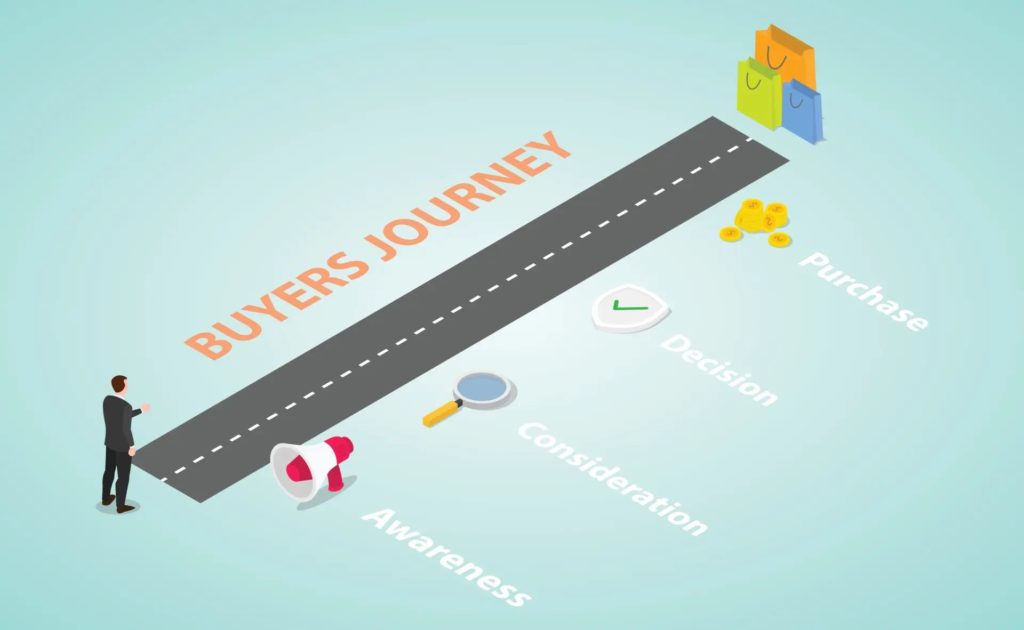
To enhance lead generation and narrow your topics, as HubSpot recommends, link your article goals to the buyer’s journey stages: Awareness, Consideration, and Decision-Making.
- Awareness: Introduce your business, staff, mission, and offerings. Highlight new products or events to familiarize customers with your brand.
- Consideration: Customers are comparing options. Provide information that helps them decide, like a “how-to” article showcasing a product or service.
- Decision-Making: Customers are ready to buy. Show them the benefits of choosing your business to influence their decision and encourage them to contact you.
This approach subtly sells by informing your customers about your products and services.
2. Finding the Format: Another Way to Generate an Engaging Topic
Knowing your goal and the buyer’s journey stage leads to your subject matter. Narrowing down the subject refines the article template. The format may also frame the topic.
Newsletters in niches like finance, AI and tech, health and wellness, and personal development grow 27% faster with 2.3x higher ad revenue due to focused content strategies.
What’s a Business Newsletter Article Example?
Common newsletter article examples:
- An editor’s or “welcome” note: example: Sundvick Legacy Center
- A short news item: sample: Dwyer, Spino & Goncalves newsletter
- A teaser for a blog post that links to the full piece: examples: DFD Russell Medical Center newsletter; Aviva Senior Living newsletter; HORNE newsletter
These formats are simple enough to write with little planning, saving you time and energy.
More examples of company newsletter articles:
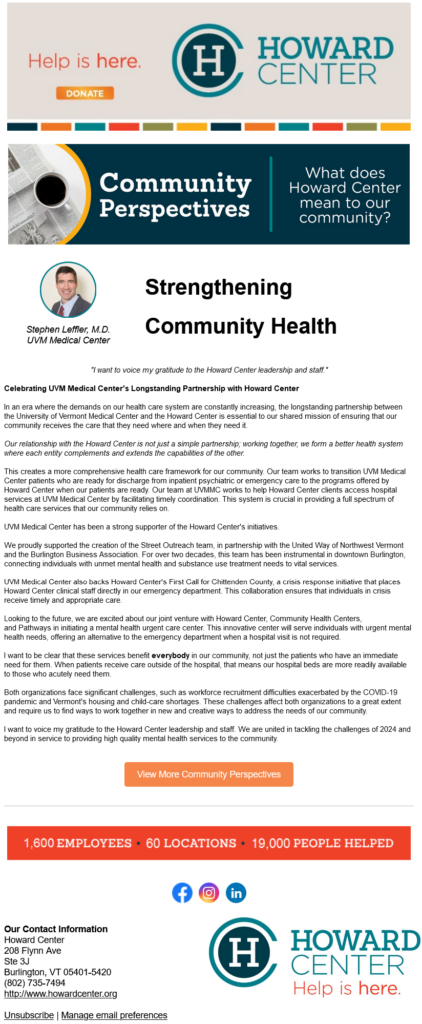
Often, e-newsletters feature one main article with snippets of text and links to more information.
- The Howard Center e-newsletter (pictured) features a nearly 500-word article.
It’s among several strong healthcare newsletter examples. Learn more in What Are The Best Health and Wellness Newsletters?
- How to write a newsletter article sample from a law firm: The Law Office of Antoinette Bone: Estate Echos. This e-newsletter features one 400-word article aimed at fellow advisors or consultants.
Explore more: writing a newsletter article template.
“Consider leveraging content curation. Not every piece of content needs to be created from scratch. Sharing relevant industry news, case studies, or insights from thought leaders can add value to your newsletter without the heavy lifting of original content creation.
Tools like Feedly or Pocket can help you gather and organize relevant articles and information.”
Gabrielle Yap, Senior Editor, Carnivore Style
Curata reports that leading marketers use a mix of 65 percent created content and 25 percent curated content, keeping their output consistent without burning out.
3. Keeping It Interesting and Useful to Hook Readers: Consider Storytelling
Your piece should be useful, or in marketing terms, offer value. One way to deliver that and to help readers identify with you is through storytelling.
Stories boost retention to 65-70% (vs. 5-10% for stats alone) and make facts 22x more memorable.
Michael Katz, who teaches professionals how to understand marketing, details his storytelling method effectively.
To find good stories, list interesting things you saw or experienced recently, like a colorful rainbow or a fun trip. Tie one to a useful business lesson or insight related to your expertise. Then elaborate on the experience. Joey Havens does this well.
If you need inspiration, AI offers a head start. Edit any AI-generated output before publishing. Without specific guidance, it could spin some fiction about your business.
“One of the most effective ways to get people to engage with your e-newsletters is to personalize the content and ways you address the individual recipients. But this is very time consuming and difficult to do all on your own.
It can be helpful to use AI to create segmented lists and personalize messages in a fraction of the time.”
Dr. Jerry Friedman, Doctor of Dental Surgery, North Jersey Oral & Maxillofacial Surgery
Corporate Visions research shows that emails personalized to certain industries had 24 percent higher click-throughs and 50 percent more scheduled meetings. According to MailModo, AI can help you segment lists and personalize emails more efficiently.
Personalized content in newsletters increases perceived product value by up to 2,706% and conversions by 30%.
4. Getting Organized: Focusing on the Structure and Writing the Article Effectively
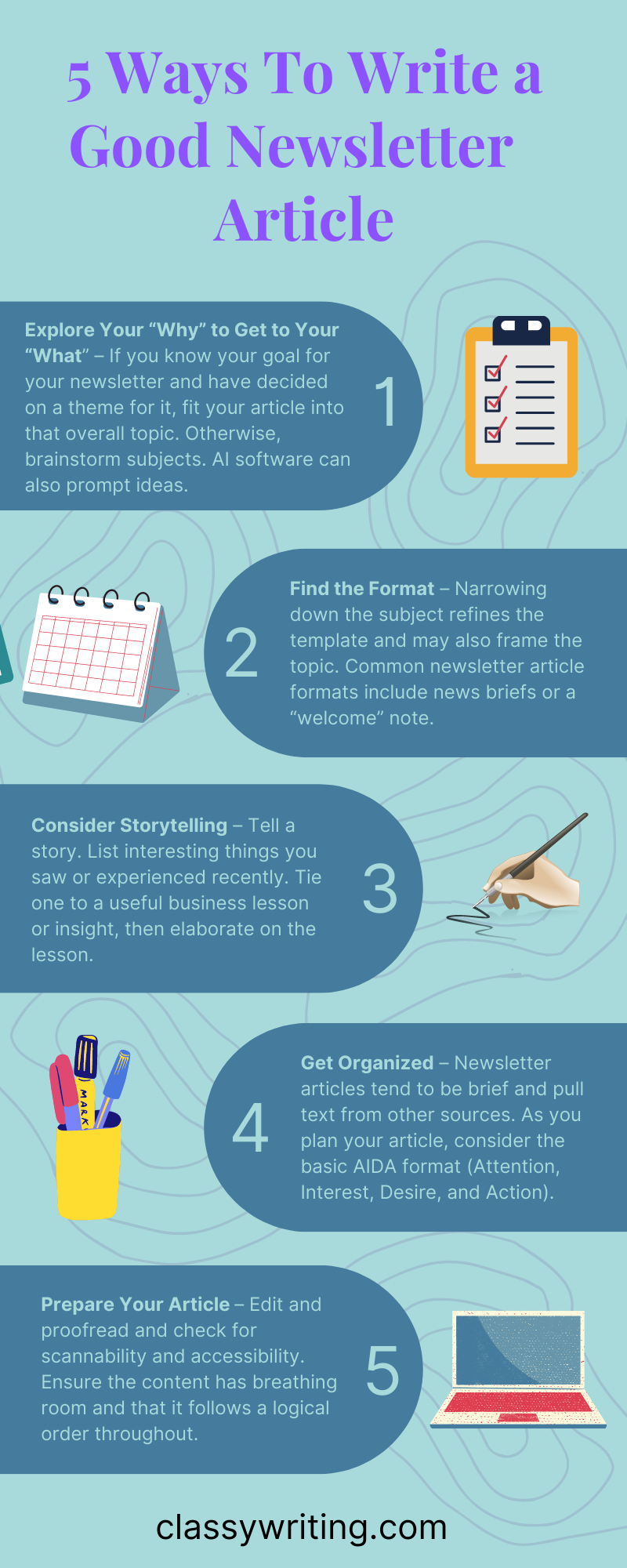
When you structure your piece, if it’s a “listicle,” number each step to simplify the format and scannability. Otherwise, as Chamaileon suggests, consider the basic AIDA format (Attention, Interest, Desire, and Action).
Business customers can be too busy to spend ten minutes reading your newsletter. Choose the length wisely while you keep your audience and what you might know about them in mind.
Should you try AI?
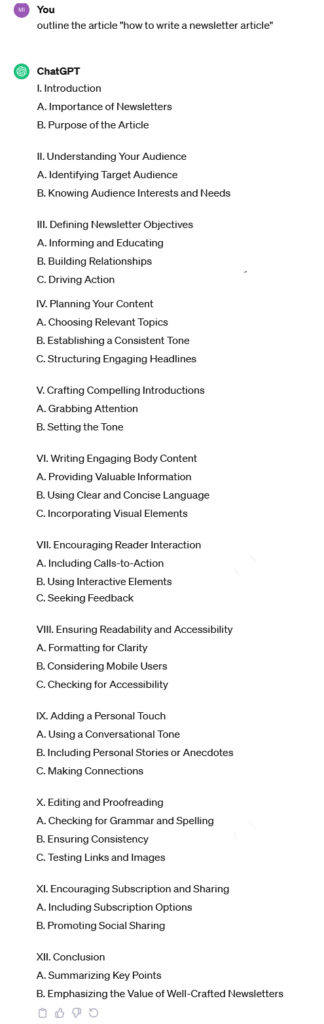
AI software can shortcut outlining, especially if you seek inspiration. For example, ChatGPT 3.5 created the pictured outline for this article.
If you’re weighing whether AI could help you, compare it to the structure of this post, which I wrote without AI. If I had given it a more specific prompt, ChatGPT might have gotten more creative.
25% of newsletter creators now use AI for content creation tasks like drafting copy, saving 1-3 hours weekly while maintaining a human touch.
How to Write a Short Article for a Business Newsletter
How to Write a Good Newsletter Article From Start to Finish: Key Takeaways
- The beginning: How will you build attention?
- The middle: How will you keep it?
- The end: How will you inspire people to act?
The beginning: your opening sentence or paragraph — how will you build attention? Get to the point powerfully. State an interesting fact, quote someone, or drop us in the middle of a scene.
- Example #1: Information articles: This Sundvick Legacy Center newsletter‘s short editor’s note starts with the fact that October is National Estate Planning Month. It then leads into why it’s a good time to consider estate planning.
- Example #2: Storytelling: Set the stage. In this newsletter, Joey Havens begins with a description of a “blue and white object laying just in front of me” in a hotel lobby.
The middle: how will you build on the interest and desire you’ve generated? Add what readers should know next to spur them on. Use transitions to tie ideas or paragraphs together smoothly.
- Example #1: Informational articles: The Sundvick Legacy Center note leads into a statistic, then builds on it.
- Example #2: Storytelling: Joey signals he has reached the middle of the piece by revealing what he mistook the object for and what it was.
The end: how will you inspire people to act? Summarize any key points. If your goal is to gain feedback, ask a question.
Use a call-to-action (CTA) to entice readers to contact you or to visit a blog or a landing page.
MailModo’s 2023 State of Email report noted that CTAs with action verbs or featured offers performed best for them. If you’re not promoting anything, close with a simple “farewell.”
- Example #1: Informational articles: The Sundvick newsletter note urges readers to schedule a consultation before another year passes.
- Example #2: Storytelling: Joey closes by emphasizing that when we lack perspective, problems can look bigger than they are. Sometimes, it’s better to wait and reexamine them with fresh eyes.
As you write (or edit), heed the guidelines from the AMA Handbook of Business Writing.
Whether you start in the middle, write the end first, or the beginning last, just write. If you like, save the headline for last. Whatever you do, don’t judge your writing. Listening to your inner critic can stifle your writing; you could start to read what you’ve written and begin editing, which is a “no-no.”
Why? Because often it’s better to let your words rest or to “sleep on them” and return with a clearer view later. It’s like buying a cut-glass vase and spotting a chip in it once you’re home. The flaws become clearer after your mind has had a break.
What’s a Business Newsletter Article Example by AI?
This is part of 5 Ways to Write With Style, an article I asked Google’s Gemini to write. I didn’t use its content in the article.
Its style differs from mine. I’m less enthusiastic, for starters. 🙂
5 Ways to Write with Style and Captivate Your Audience (Like a Boss!)
Ever feel like your business writing falls flat? You’re not alone. Many business owners struggle to craft content that’s both informative and engaging. But fear not, fellow entrepreneur!
Here are 5 powerful ways to inject style into your writing and turn those website visitors into loyal customers…
The AI-generated edition is informative, however, the advice is found in similar articles. I aimed to find aspects of writing business owners might not always consider.
“You can’t go wrong by providing value to your readers. If you know your readers well and you have expertise that can help them solve some of their common problems, email newsletters are a great place to share that expertise.
But make sure to provide content that is truly unique and informative. You want to make sure you’re offering value and not adding to the clutter.”
Kathy Bryan, Head of b2b marketing, pathstream
Though AI can draft an article, the result could be bland or a poor fit for you or your business. If you use AI, as MarTech and SEMRush suggest, check facts or sources and edit the output to suit your brand voice, style, and tone.
How to Write a Newsletter Article About an Event Template
When you describe an event, keep in mind :
- The six W’s:
2. The H (“how”)
- who / what
- when / where
- why / wrap-up
How Do You Write a Newsletter Article About an Event?

When you summarize an event, use a similar structure. Add quotes from the hosts, organizers, or attendees, along with the agenda and what you learned. Here’s a sample.
Reframe it as a “how-to,” highlight key takeaways, or try a first-person perspective.
Adding photos with captions helps readers visualize the experience.
Encourage readers to attend future events and offer incentives like exclusive content or “early bird” discounts. Provide resources related to the event topic, like research or speakers’ websites.
How Do I Write an Internal Newsletter Article?
The steps for how to write an internal newsletter article are similar to those outlined above, yet focus more on employees as your audience. Many of the topics to cover are like those in a newsletter for clients: news and announcements, upcoming events, co-worker/employee profiles, etc.
How to Write a Newsletter Article for Work: Points to Consider
| Feature | Internal Newsletter | Customer-Facing Newsletter |
|---|---|---|
| Target Audience | Employees | Potential Customers |
| Purpose | Inform, Engage, Motivate | Generate Leads, Promote Services |
| Tone and Style | Informal, Conversational | Professional, Informative, Engaging |
| Content | Company News, Achievements, Events | Industry Trends, Case Studies, Resources |
| Call-to-Action | Participate, Complete, Provide Feedback | Learn More, Download, Schedule Consultation |
More Resources:
- How to Write a Business Newsletter: Examples, Format, and Strategy
- How to Create a Professional Email Newsletter
- How to Write a Law Firm Newsletter
5. Preparing Your Newsletter Article for Readers
When you plan your piece, consider:
- Scannability and Accessibility: Slice concepts into smaller parts for easier skimming with bullet points or numbers. Add images to break up text and make it more visually appealing. Ensure your content flows logically. Also, consider accessibility for people with disabilities: use short words, sentences, and paragraphs without jargon.
- Editing and Proofreading: polish your email for professionalism before you send: print it out, read it aloud in a flat voice, or have others check it to catch errors.
The Harvard University Graduate School of Education offers more Email Newsletter Best Practices worth reviewing.
Now that you know how to write an article for a business newsletter, if your words are flowing, it will almost write itself. And when your masterpiece is ready, add it to your latest newsletter and share it on social media and elsewhere.
To stop stressing and start impressing everyone with your messages, get the free Easy 5-Step Business E-Newsletter Template.
- First published: April 3, 2023
- Last updated: March 2, 2026