How to Write a Business Newsletter: Examples, Format, and Strategy

Knowing how to write a business newsletter can help you gain more leads, especially when you emphasize your expertise, which builds authority and trust. But if you’ve never sent one before, where do you start — with the design, the content, or both? Will people even read it?
As a blank screen stares back at you, you may feel overwhelmed. Keep calm and read on to learn all about writing a business newsletter from start to finish.
- What Makes a Business Newsletter Effective?
- What Should Be Included in a Business Newsletter?
- What Are Some Business Newsletter Examples?
- How Do I Create a Newsletter for My Business?
- AIDA: Attention, Interest, Desire, and Action
- What Should I Write in My First Newsletter?
- How Do You Write a Business Newsletter Template?
- How Do You Sign Off a Newsletter?
- How Often Should You Send a Newsletter?
- How Do I Make a Newsletter for Free?
- How Do You Write a Business Newsletter?
What Makes a Business Newsletter Effective?
A business newsletter informs potential customers about products or services. The elements of an effective business newsletter include enticing subject lines and an engaging structure.
What Should Be Included in a Business Newsletter?
A successful newsletter starts with a well-defined content and design plan. Identify your target audience, determine your newsletter goals, and set a consistent publishing schedule.
- Michael Katz of Blue Penguin Development suggests you answer the question, “What is this about?” in one clear sentence. And aim to give your readers information that will appeal to them. Ideally, it will help them do better jobs or live better lives.
- If you publish blogs, social media posts, or press releases regularly, add your newsletter to your content marketing mix. Use it to recycle or reinvent existing content. Consider how your messages fit into your content calendar.
- If you’re in business, your priority may be to get more leads, which can eventually turn into sales. You can address every stage of your buyer’s journey, from their awareness of your business to consideration, decision-making, and loyalty.
So, feature content that informs potential customers about you and your products or services, and how you can help them.
Content Ideas for Building a Relationship With Your Readers
- News or upcoming events: your own or from sources you credit
- One or more of your recent blog posts (links with or without summaries)
- Discounts, special offers, or giveaways (a free guide, a prize drawing, etc.)
- Your thoughts on a topic tied to your product or service
- Readers’ comments, including questions and answers
And it doesn’t have to be all business. Katz also recommends you blend stories about your life experiences with your expertise to connect with readers and build trust.
A more personal touch may make you stand out as someone people can relate to rather than a faceless brand name. It could also keep your copy interesting. Their responses to it show its popularity or how well it converts.
When writing a company newsletter, consider:
- The purpose of the content and if it suits your message’s theme; if not, find another topic. To refine your subject, link your article goals to the different buyer’s journey stages.
- The writing style: will it be informational or tell a story? Will you go for laughs?
- The outline or structure.
Artificial intelligence can help, but check any facts for accuracy and tailor any content it generates to your unique brand voice, language, and tone.
How to Write a Business Newsletter: Tailoring Your Content to Different Audiences
Consider segmenting your audience by their needs and interests. This lets you craft content that connects deeply with each group. By offering a variety of content formats, you can cater to different learning styles and preferences. Here’s how.
1. Know Your Audience: Segment your target market based on factors like industry, company size, or legal or financial needs to address their challenges or goals. Potential segments for a professional services firm:
- Startups: They might need help with forming a legal entity, fundraising strategies, and navigating early-stage regulations.
- Established Businesses: This segment could benefit from content on contract negotiation, intellectual property protection, or tax-saving strategies.
- High-Net-Worth Readers: This group might be interested in estate planning strategies, wealth management tips, and asset protection.
2. Craft Content in Their Language: Once you know your segments, change your language accordingly. Examples:
- Startups: Add terms familiar to them like “seed funding” or “minimum viable product (MVP).” Simplify complex legal and financial concepts clearly.
- Established Businesses: Use industry-specific jargon relevant to their field (e.g., “marketing and advertising law” for an ad agency). Provide in-depth analysis of legal or financial issues that affect their operations.
- High-Net-Worth Readers: Explain wealth management and estate planning in formal language like insights on complex investment options and tax benefits.
3. Variety Adds Spice: Don’t bore your audience with the same format. Mix it up with different content to show your expertise:
- Startups: Show infographics on business formation, offer Q&A sessions with legal or financial experts, or checklists for essential tasks.
- Established Businesses: Share case studies featuring successful client outcomes, publish webinars on industry trends and legal updates, and go in-depth with exclusive white papers.
- High-Net-Worth Readers: Feature interviews with wealth management specialists, discuss tax law changes that affect their portfolios, or grant access to gated content on estate planning strategies.
4. Track and Analyze: Track your email analytics to see how different segments respond to the content. Use this data to refine your strategy and give each audience useful information.
“I’ve picked up a few email marketing pointers along the way as a real estate investor. I’ve found that personalization is key — I always tailor my newsletters to the specific interests and needs of my audience.
Plus, consistency is crucial. I make sure to send out regular updates to keep my subscribers engaged. And don’t forget about valuable content — I strive to provide useful information that adds value to my readers’ lives.”
Harpreet Saini, CEO, We Buy Houses
5 Business E-Newsletter Must-Haves
Crafting compelling business emails requires a strategic approach. Five best practices to consider:
- Plan for Scannability: People skim emails. Structure your content with clear headings, bullet points, and concise language to enhance readability. Many email marketing platforms offer mobile-friendly templates.
- Embrace Consistency: Set a regular format to streamline creation and enhance familiarity, like a welcome message, featured articles, and a call to action.
- Fuel Your Content Engine: Keep a three to 12-month content calendar. Explore content curation tools to collect industry news. Don’t be afraid to repurpose existing content like blog posts or white papers: reframe, summarize, and link back to your sources.
- Content that Converts: Newsletters educate and nurture leads. Craft catchy headlines, interesting body copy, and clear calls to action. Share your unique experiences and insights to connect with your audience.
- Stay Compliant: Ensure your email complies with laws and standards like CAN-SPAM (U.S.), CASL (Canada), and GDPR (Europe). This includes having clear unsubscribe options and avoiding deceptive subject lines.
Follow these practices to send informative, engaging, and legally sound messages.
Explore how to write a law firm newsletter, including law firm newsletter topics, law firm newsletter templates, and legal newsletter examples for clients.
The Best Business Newsletter Structure
Research and marketing firm Fenwick studied 100 email newsletters by B2B (business-to-business) companies in different industries. They found four common newsletter formats:
- The Summarizer: about 69 percent of the emails repackaged pieces the firms had already published
- The Hard Sell: 18 percent of the messages focused on product/service benefits
- The Homepage: eight percent of the newsletters curated content from across the web and provided analysis/context
- The Forwarder: five percent of the emails the firm generated when it published a new piece of content without any context
Need more ideas? See the business newsletter writing examples below.
What Are Some Business Newsletter Examples?
If you run a professional services firm (lawyers, insurance, real estate agents, etc.), see these business newsletter examples. I also have some thoughts on healthcare emails.
Among 501(3)(c) charitable nonprofits, I like the National Hemophilia Foundation’s HEMAWARExpress. It features a tasteful design with images and brief descriptions that link to the full articles. The headlines are short. Other copy, such as the sponsored content, is formatted into two columns to stand out from their own articles.
Every image is eye-catching, designed to help tell the story. The newsletter could, however, be shorter. With fewer content blocks, readers would scroll less and save time.
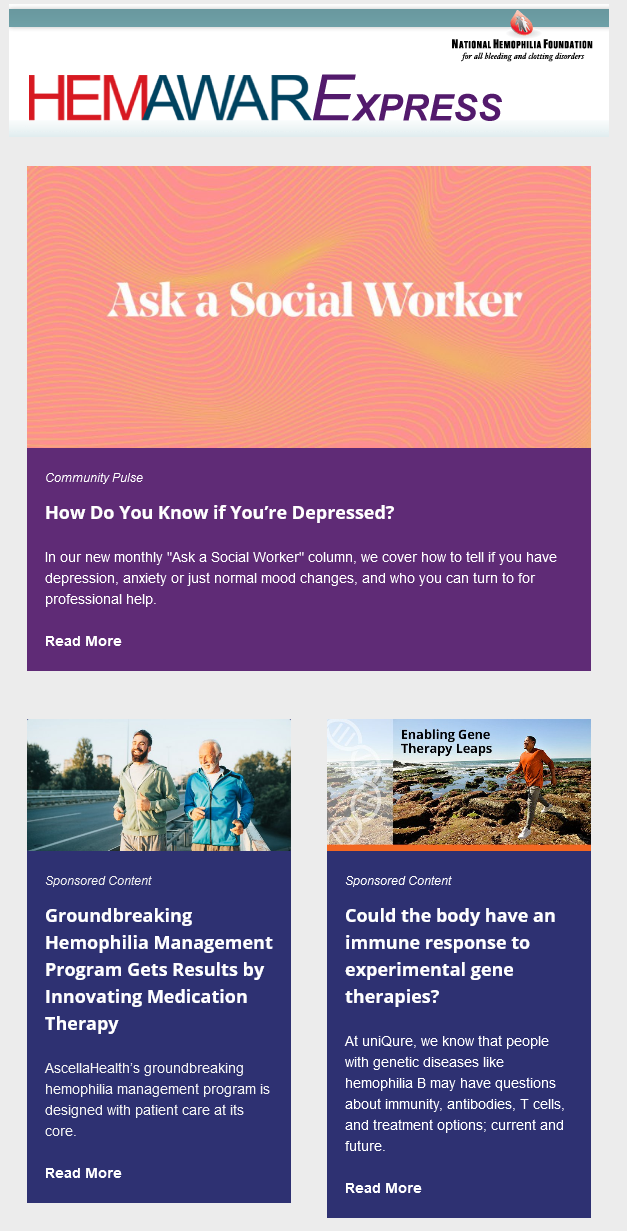
Editing tip: Make sure your headlines follow a consistent case style.
In the example above, one of the headlines among the sponsored content is lowercase, but the rest of the words in the headlines are capitalized. Consistency is key for easy reading.
I’ve created e-newsletters for economic development nonprofits. One of my local chambers of commerce, the Bangor Region Chamber, excels at keeping its content and design short and sweet, without bold colors, large fonts, or other distractions.
These best business newsletter examples can guide you in choosing your newsletter content, design, and style. As shown, depending on your audience and subject matter, your copy should keep a friendly and informational tone throughout.
How Do I Create a Newsletter for My Business?
Next to your copy, the design also determines the basic business newsletter structure.
AIDA: Attention, Interest, Desire, and Action
- Attention – Start with a compelling subject or headline — the first thing readers will see. Use power words, numbers, emojis, news, or scarcity (“This Friday Only”). Subject Line, Sharethrough, Advanced Marketing Institute’s Headline Analyzer, and other analyzers can help you choose click-worthy titles. If your email marketing platform allows for it, add preview text. It can offer more details to influence opens through helping readers see the value of your email. Inside, much of the age-old writing advice for articles applies, such as writing an appealing opener. Generally, that involves stating an intriguing fact, adding an interesting quote, or asking a question. Personalize the copy to users’ interests or behavior. Images should also draw readers in.
- Interest – After you’ve started, the challenge is to keep people reading. HubSpot suggests you do that through “building relevance.” If you know why you’re sending your newsletters, ask yourself, “What value are they going to get from it?”
- Desire – Build on the initial steps: show readers the value of your product or service.
- Action – This is the goal of your email. It involves a clear, persuasive, and eye-catching “call-to-action” (CTA), such as a sentence or a button that links to more information. Action verbs help. Focus on the benefits of the content — what readers will get from it — to earn clicks.
To write a great CTA, HubSpot recommends you ask yourself:
- What do I want the reader to do?
- Why should they do it?
- How will they know to do it?
Beyond CTAs in link form, buttons are easy to see and click on, especially on mobile devices. Ensure the buttons are large enough for users to comfortably tap with their fingers. Add white space around them.
Also, write clear and concise button text that conveys the action you want readers to take. Some copywriters suggest you use the word “me” or “my” instead of “you” or “your” in your CTAs to enhance their appeal. Add a benefit: show what readers will get.
Examples:
- Discover Tax Tips for 2027
- Seek Expert Advice Now
Keeping It Simple to Maintain Interest
Whatever you decide to include in your emails, the Content Marketing Institute recommends they be “simple and focused.” Stick to one topic. If you must add more information, mention it briefly after the body of the email. Too many details stop the flow and decrease interest. The text should be conversational and helpful, in a tone appropriate for your brand and your target market or buyer’s “persona.”
Some experts recommend the average newsletter be 300 words or fewer, or about six to seven lines of text per message, with simple words, short sentences, and action verbs.
Research backs this up. The Nielsen Norman Group (NNG) analyzed 117 newsletters with infrared emitters and webcams to capture people’s expressions. They also used eye-tracking heat maps that showed where users looked.
- Their research reveals that people tend to skip introductory text. A little over one-third (35 percent), skimmed or glanced at the material.
- Another of their usability studies of ten emails showed “users have highly emotional reactions to newsletters.” Because they arrive regularly in their inboxes, they tend to see them as an ongoing relationship, with more of a bond between them and the company than a website or a blog.
- And the format must be simple. Only 23 percent read them thoroughly. Users skimmed, scanned, or didn’t open the rest.
- A heat map, like those the NNG used, that connects to your email platform, can note where people look. Tracking readers’ activity, including open rates, helps you determine future content.
Later, we’ll cover how to create a newsletter template to house your content.
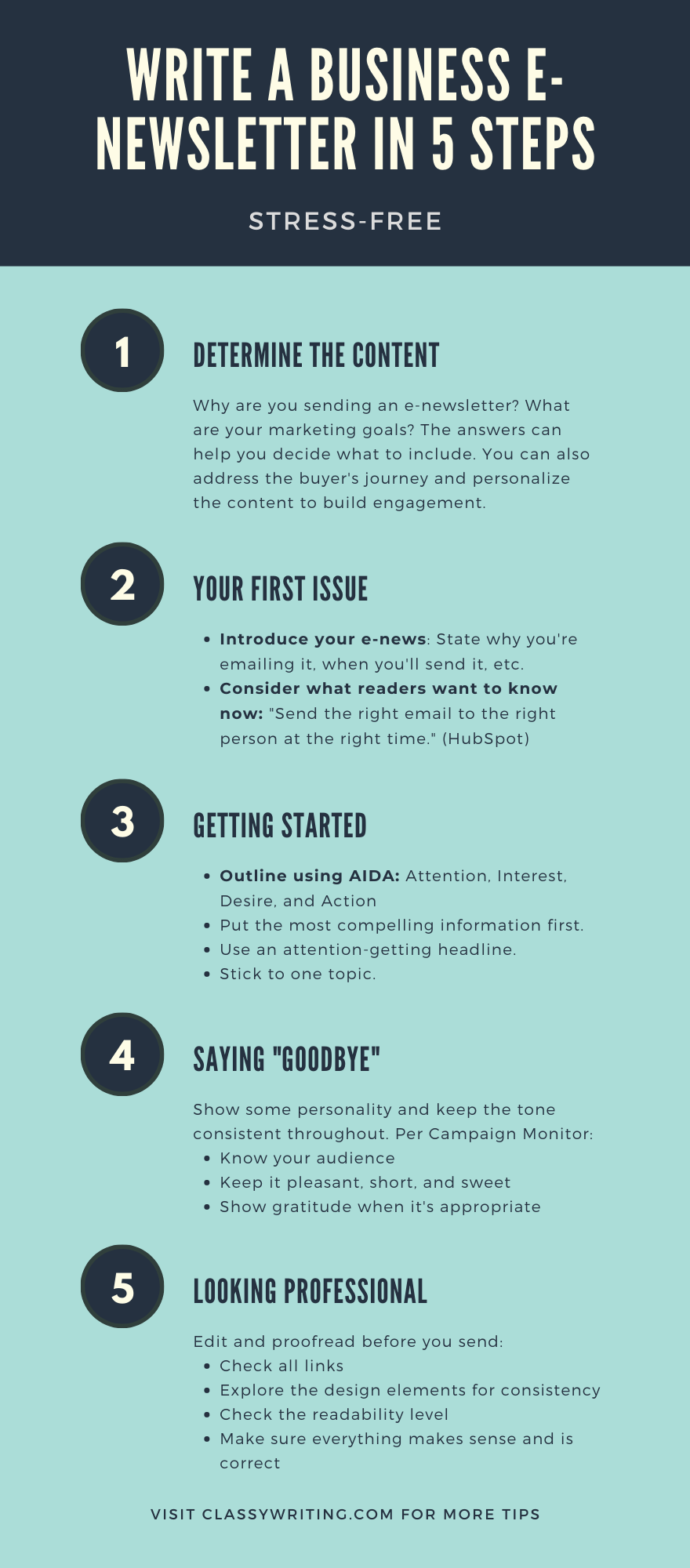
Get The Easy 5-Step Business Newsletter Template
What Should I Write in My First Newsletter?
Your first newsletter can set the standard for later emails. It may serve as an introduction, apart from a “welcome” message or script you send new subscribers automatically. It can also state the purpose of your newsletter and cover content you feel is vital for readers. And when they can expect to receive it.
HubSpot uses a holistic tactic to writing a company newsletter. They suggest you “consider how to send the right email to the right person at the right time.” They recommend you ask yourself:
- When will this contact see value in this email?
- Will they be able to do something with it right now?
- Is this information relevant to their needs or goals?
Each potential customer is at a different stage in the buying process; some may be in an “awareness” stage and need more educational content, but others are still deciding and need more information, like a consultation.
How Do You Write a Business Newsletter Template?
Popular email marketing platforms like MailChimp and Constant Contact offer templates customizable with your own colors, text, stock photos, and branding.
You can also choose premade templates based on the audience and subject matter. They typically feature a header and a footer, with one column throughout or a mix of one- and two-column content blocks. There’s usually only one of each column style per email.
Fenwick suggests you keep the design simple (like your writing). The B2B newsletters they studied “buried whatever point they hoped to make in walls of tiny text, crammed non-essential images into two-column formats (not a death sentence, but difficult to pull off).” They also “produced an experience that felt nothing like their website.”
The newsletters Fenwick ranked the highest were:
- An average of 241 words long
- Used fewer images
- Had one column
- Featured the same colors and branding as the company websites
Get a five-step e-newsletter template — see where to place content to get attention.
“We used automation tools like Mailchimp and Constant Contact to design our newsletters. They helped segment our audience and personalize content for higher conversion rates.”
Fahad Khan, head of Digital Marketing, Ubuy Nigeria
What Does A Well-Designed Email Look Like?
Fenwick gave the average newsletter a score of 1.83 out of three — just below average; newsletters in their top ten percent achieved a 2.6. They granted only 20 percent of the companies high marks.
The top email newsletters were simple, visually appealing, and kept readers’ attention throughout. “The lowest-scoring email newsletters were cluttered, poorly formatted, and featured several different nested headers, many columns, and a disorienting amount of text.
Perhaps unsurprisingly, great writing and great design are connected. Companies that have good copy also have good design instincts and vice versa.”
Planning Your Newsletter for Business by Design
MarketingProfs suggests you type or hand-draw a basic design before you begin. If you’re working with a designer or programmer, you can give it to them, and they can go from there. They also suggest you ensure the look and feel are clear and consistent with your brand and its voice.
HubSpot recommends you keep the type of device your readers will use to see your messages in mind. Smartphones have among the smallest screens.
Plain text emails work best for newsletters that focus on content. This business newsletter writing format is also helpful if you’re linking back to a blog post or a website. Newsletters in HTML may be more eye-catching than text.
“Regardless of which type of email you are sending, your reader needs to know what you’re trying to convey. Aim for a clean, straightforward design to display the value you are sending.”
Hubspot
Design Elements That Drive Engagement
Think about the different elements of your email. The top, or header, should be a focal point — put details you want people to see first here, like your logo.
Headers, links, bold text, and white space throughout emphasize certain parts of your newsletter, making it scannable.
White space is a crucial design element. It gives your content room to breathe, breaking up text and images to enhance readability. Effective newsletter design uses it strategically. Margins, gutters, and spacing between lines add to an appealing and easy-to-read format.
In most email marketing platforms, the standard width is 600 pixels. But you may change the settings to suit different screen sizes to make a professional email newsletter.
How to Create an Engaging Design Template
HubSpot uses the following steps when creating a template to show the reader value, explain the action they should take, and create a conversation that feels natural:
- Set a goal.
- Outline your email design; write and design the content to involve the reader in your conversation (and convert).
- Focus on creating a consistent experience.
- Bring everything together and create a call to action to guide the reader to their next steps.
Essentially, everything should support the goal of your message and be consistent throughout. And format the writing and the design elements for easy scanning and reading across all devices. That’s another part of building a relationship with your readers.
ADA Guidelines for People With Disabilities
An overlooked part of newsletter design is compliance with accessibility standards like the Americans with Disabilities Act of 1990 (ADA) and the European Union Accessibility Directive.
The ADA requires certain businesses to accommodate people with disabilities. Web content for them should be accessible for navigation by voice, screen readers, or other assistive technologies. ADA guidelines apply to:
- Businesses that run 20 or more weeks yearly with at least 15 full-time employees
- Those that provide public accommodation, such as inns and restaurants.
Often, people believe websites must be ADA compliant — they can be subject to fines if they aren’t — but newsletters and emails aren’t often discussed. The ADA guidelines aren’t specific. Many of them are based on Web Content Accessibility Guidelines. The ADA legal requirements for an email include:
- Maintain a logical reading order
- Use heading elements in code — if you rely on templates and don’t know HTML, this won’t apply
- Include enough contrast between text and background colors (WebAIM contrast checker tool)
- Provide “alt text” for images
- Feature meaningful link text
- Keep your code concise (not applicable if you rely on templates)
- Use a descriptive subject line
Also, check how your emails look in light and dark modes and if necessary, change your design elements to improve accessibility. The dark mode setting in email clients shows the text, icons, and other user-interface elements in light colors against a dark background.
Adjusting Your Newsletter Design Further for Readability
The design elements can also include providing enough space around your text and not using colors that are too similar. Some people might find italics hard to read.
Links, ideally, include three or more words. Linking to an entire sentence (if it’s short) can be easier to read. Campaign Monitor recommends avoiding “click here” and “read more,” in favor of the more precise, like “Read our recommendations for better links.”
The content should make sense and work well with other devices, such as screen readers.
A descriptive subject line should refer clearly to the newsletter content.
Example: “Picked for you: Light Wash Jeans” (Levi’s®).
Whether or not your business must meet government accessibility laws, it’s practical to make your content easy to read for everyone.
Mobile-Friendly Elements of Design That Enhance Appeal
Today, many people read emails on smartphones or tablet PCs. Responsive design ensures your newsletter’s layout automatically adjusts to fit their screens.
For faster load times, use fewer images and keep them fairly small. To ensure smooth viewing on mobile devices, resize your images to dimensions appropriate for your content. MailChimp, for example, prompts users to size graphics 800 pixels wide and 600 pixels high.
Free tools like Irfanview or Promo’s Free Image Resizer can resize graphics. Also, consider image formats designed for web use like JPEG or PNG, which balance quality and file size effectively.
Though they can look good on desktop screens, too many columns can confuse readers and be harder to navigate on mobile devices. Consider a single-column layout; on smartphones and tablets, the text and images stack neatly on top of each other.
When you’re ready to test your design, check how it looks on all devices through your email platform or send yourself a copy.
“Establishing a template with minor customizable parts can drastically cut down on design time. For instance, at Businessmap, we have an evergreen template featuring our brand colors and fonts, but we switch up images and texts per edition to keep it fresh.”
Pavel Naydenov, Marketing lead, methodia

Source: Email Design Best Practices – Email Uplers
How Do You Sign Off a Newsletter?
Depending on the content, each “block” or section can have its own call to action (CTA). These usually appear at the end of the block. Campaign Monitor recommends you add some personality to the end of your newsletter or CTA. Your final message should match the tone of the rest of your content.
They suggest you:
- Know your audience
- Keep it pleasant, short, and sweet
- Show gratitude when it’s appropriate
Less is sometimes more.
How Often Should You Send a Newsletter?
The short answer: it’s up to you. 🙂
If your emails will feature the latest news or promotions, it could be better to send them daily or weekly. For evergreen content, every two weeks or once a month can work well. At the least, no less than four times a year or quarterly.
Ann Handley of MarketingProfs offers these rules of thumb:
- Quality matters more than frequency (with some exceptions). It takes her about eight hours to write and publish her newsletters, hence she issues them every two weeks. She also believes there’s no “right answer” to the question of how often you should publish. To her, weekly or every two weeks is a minimum. She sees monthly as too infrequent.
- “Write only when you have something to say” doesn’t work. (The Content Marketing Institute has promoted that philosophy.)
For professional services firms or solopreneurs, Michael Katz advises that every two weeks is fine; he publishes his on that schedule and finds that “it keeps me very visible and top of mind.” And he says that nearly all of his clients publish theirs monthly.
For many people, more often is too much work. He reasons that with social media and other tools, you can get more mileage out of your newsletter through posting on other platforms. Like other forms of content, newsletters yield benefits over time.
Research can help you decide the best schedule. Fenwick suggests that “For a newsletter to remain enjoyable, one email per week is probably fine.” Their analysis found that companies sent an average of six emails monthly. The ones they ranked in their top ten percent averaged 11 per month. They advise that sending an email every other day is a lot and suggest sticking to the average.
How Do I Make a Newsletter for Free?
Few email marketing platforms are truly free; many of them offer limited trials and then charge a monthly fee based on the number of subscribers and/or how often you send.
MailChimp is among the most well-known free providers for lists of 500 or fewer subscribers. It offers a decent variety of templates for non-designers or programmers, but if you know HTML, there’s an option for that.
You can also preview your newsletters, send tests, and check links. And you can send every new subscriber a “thank you” or “welcome” email. Plus, the platform provides solid metrics, letting you track clicks and opens, including the best dates and times for sending. A/B tests are available for paid accounts.
Other services offer similar options based on the number of contacts and emails you send.
Mailjet: the free limit is 6,000 subscribers and 200 emails daily. Their plan includes:
- Unlimited contacts
- APIs
- SMTP relay
- Advanced statistics
- Webhooks
- Advanced email editor
Kit (formerly ConvertKit): their free plan for up to 1,000 subscribers includes:
- Unlimited landing pages and forms
- Sending email broadcasts
- Selling digital products and subscriptions
- Email support
Other extras are available through their paid plans.
Sender‘s free plan includes:
- Access to all features, including automation
- Up to 2,500 subscribers
- Up to 15,000 emails per month
Sender offers several features suitable for everyone, from bloggers to businesses of all sizes and types.
Among the notable options are automation in the form of product data added to emails from a link and the ability to collect user data after a purchase. Like other platforms, Sender provides:
- Templates
- Segmentation
- Personalization
- API
- Social sharing
- Automated welcome messages
- Email sequences
But compared to other ESPs, their free plan has more generous subscriber and email send limits.
Though it might seem small compared to more famous email service providers, Sender boasts more than 300,000 users, including brands like Deloitte, Disney, and the World Wildlife Fund. It’s also fairly versatile, supporting integration with apps like Cloudflare, WooCommerce, Zapier, WordPress, and Shopify.
“Automation is a game-changer. Leverage email marketing software to automate certain aspects like sending the newsletters, tracking performance, and adjusting strategies based on analytics.”
Gianluca Ferruggia, fractional cmo & Cro, digica consulting
Blogging and Social Newsletter Platforms
Sending a newsletter directly from a social media platform or a blog can be easier than using an email newsletter provider. Essentially, your blog serves as the newsletter, as you email everyone an update whenever you post.
Creating the newsletter on the platform is more “plug-and-play,” and doesn’t require coding or much design, saving set-up time.
Some popular free options:
Depending on the platform, you might not own all of your data there, namely your subscriber list. As Ann Handley of MarketingProfs has said of LinkedIn, access to that data can be a problem if the company folds. Major changes could also happen under new owners, like when Elon Musk bought Twitter.
These platforms could also change their content policies and limit what they deem acceptable for posting.
If you meet the access criteria and have over 150 followers on LinkedIn, you can make newsletters through a personal profile or a company page. Google and other search engines may index them, and with LinkedIn’s high domain authority, they could outrank your website or blog content.
Sending an existing newsletter through the platform can cross-promote your content to a wider audience. Once you publish, unless you’ve opted out, everyone in your network will be notified.
beehiiv and Substack: Social vs. Blog Hosting
beehiiv and Substack look similar. Substack is more of a social platform, letting people react to posts and offering audio/video features, including podcast hosting. It’s geared more toward those interested in monetizing their content.
Both sites let you email blogs to an established list for free. If you decide to charge for subscriptions, however, Substack will get a 10 percent cut and their payment processor, Stripe, will take 2.9 percent plus $0.30 (USD) per subscriber transaction.
Compared to Substack, beehiiv is more SEO-friendly and is more of a web-hosting blog service. It bills itself as the solution for writers who want more flexibility and options, like access to surveys and advanced analytics (mainly for paid users). It’s free for lists of fewer than 2,500 subscribers with unlimited sends.
With its application programming interface (API), it’s similar to a provider like MailChimp.
How Do You Write a Business Newsletter?
After you write a business newsletter, check for errors. A thorough read-through to catch mistakes before you hit “send” will make your newsletter look polished. Email yourself and anyone else on your team a test message (or three). Use this list to spot mistakes:
- Check all links.
- Nowadays, many email marketing platforms convert your e-newsletter content for viewing on mobile devices. Explore the design elements, like font sizes, colors, and links to images, for consistency across all devices. Is everything easy to read and scan? Keep your sentences three to four lines long (or less) to enhance scannability.
- Check the readability level. Some grammar experts recommend your content read at an eighth or ninth-grade level or below. To check the level, use The Hemingway App.
- Edit and proofread.
- Ensure everything makes sense and is correct, including any names, dates, and times. Figures should add up.
If you follow all the steps I outlined above and avoid mistakes, you’ll be well on your way to mastering how to write a business newsletter.
The best of luck to you in your efforts!
- First published: September 7, 2021
- Last updated: June 2, 2026