5 Business Writing Principles AI Can’t Fully Resolve

Before I hit “enter,” I intended to ask Perplexity if business writing principles in the AI age would fit with my existing content. “Yes,” it replied, then advised me on how to judge that — without asking which topic.

Generative AI is often better at following, not leading, sometimes because it’s programmed to serve. It’s still developing.

I’m making the case for following professional business writing grammar rules despite its widerspread use. So, this isn’t about trimming em dashes or other alleged “tells” to avoid being accused of having a robotic touch.

I maintain it’s better to strive for accuracy (like I was taught in school) and will keep aiming for that sheen, with and without AI.

Does being concerned about whether copy was machine-generated make sense?

Large language models behind ChatGPT, Claude, and their cousins learned English from us. Like humans, especially without clear directions and despite access to libraries of knowledge, it can still craft grammatically incorrect rough drafts.

Whoever does it, bad writing can tarnish your image. If you know good grammar and tools, though, AI can be an effective editor. I’ve used it for years, starting with spelling and grammar checks in software like Microsoft Word and Grammarly.
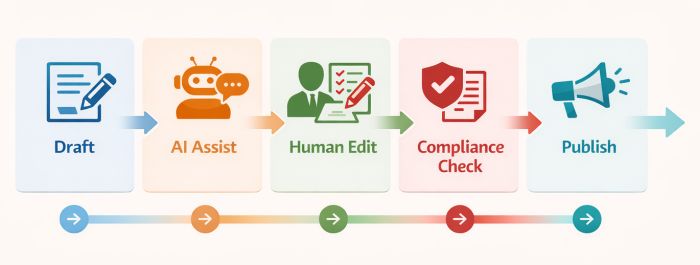
A clean linear flowchart with five stages: Draft, AI Assist, Human Edit, Compliance Check, Publish.

5 Business Writing Principles That Still Matter (Despite AI)

Some businesspeople are “all in” on AI. Others aren’t. In some professional services fields that require accuracy (like law), the use of AI can violate rules of conduct.

Here’s what many business professionals (including me) still struggle with — and AI does and doesn’t resolve effectively.

1. Readability – Unless you’ve given AI tools precise instructions, their output can be wordy and veer into complex terms, padding your editing time. It depends on the topic, the prompt, and the tool, though.

In a 2023 study of patient information materials, ChatGPT improved readability but couldn’t always reach recommended low-grade levels; Google Bard (now Gemini) reached a sixth-grade reading level but sometimes omitted up to 83 percent of the original content.

Even when we use our brains, some of us sound stuffy, writing more for college professors than everyday people. I’ve done it. The occasional long sentence, big word, or chunky paragraph is fine. No harm done. Just remember who you’re writing for and consider if your text reads like mumbo-jumbo.
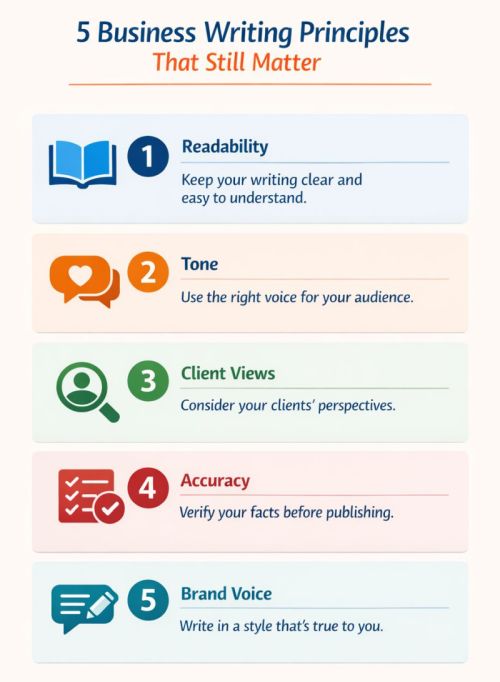
Five business writing principles that still matter: readability, tone, client views, facts, and brand voice.

2. Tone – AI can grasp the nuances of emotions based on what has been written. But it can’t see through your eyes. If you’re aiming for a certain tone, it can fail to convey it with the right level of emotional intelligence or “soul.”

Example: If you ask it for advice on respectfully asking a colleague to take out the trash (after the fourth try), AI might suggest:

“Team effort time: Trash is full again — want to grab it, or should I?”

But it might not give you the right wording to discuss the deeper issue: why your colleague keeps forgetting. It can make suggestions, but ultimately, what feels right is your call. And when you need to broach a sensitive topic, wouldn’t it be better to talk than text?

3. Client views – You or AI can dig into data about your clients — your own or by others. That information can help you find problems and predict solutions. You can create avatars that resemble customers and consider what they might say. But you don’t always know what your readers think unless you ask them.

Giving customer data to AI raises ethical and privacy concerns, and for some professional services firms, confidentiality issues with legal consequences. States like California and Utah mandate AI disclosures in consumer interactions and ban unverified use in regulated fields. Ethical violations now include skipping human review in client work.

Unless you prompt it to spot them, AI might also ignore biases in data and rely on stereotypes.

4. Facts – We and AI can fudge details, like miscounting the number of references to “you” in this blog. (Perplexity counted 35, I counted 22.)

How reliable is AI for factual accuracy? Across models like GPT-5.2 and Claude, 2026 benchmarks show hallucination rates of 15 to 52 percent, though techniques like retrieval-augmented generation (RAG) can cut them significantly.

In my experience, for research, among the major AI bots, Perplexity is the most consistently accurate. I appreciate the well-organized links to sources, which, surprisingly, Google’s Gemini doesn’t offer without asking. To an extent, all of the platforms hallucinate — some more than others.

Trust, but verify.

5. Brand voice or writing style – If your content doesn’t sound like you, it lacks authenticity and can fail to reach clients. They’ll see through the false front or ignore copy that looks the same. Generative AI can worsen that by putting words in your mouth, creating more work.

Arguably, only you can add your personality to your writing, because your brand voice reflects how you speak to your customers.

Having a company style guide (or following an existing one like The Chicago Manual of Style) helps you make your copy look and sound more consistent. It can include words to use and avoid, or advice on formatting documents like press releases. The sky’s the limit.


Whether or not you use AI or it continues to improve, we’ll likely keep wrestling with these business writing principles. If you use AI for content creation, consider an “AI-U” process — have a human review the final draft.

Either way, when we strive to create solid business writing, we must take responsibility for our successes or failures — because our writing projects who we are.

Does your content sound like you — or everyone else? A copy audit shows what’s working, what’s not, and how to strengthen your brand voice to connect with clients.

What do you think of AI? Are you checking whose writing has the robotic touch? Leave a comment below.

Business Writing Principles FAQ

1. What are the five stages of business writing?

According to Scribbr:

Step 1: Prewriting.
Step 2: Planning and outlining.
Step 3: Writing a first draft.
Step 4: Redrafting and revising.
Step 5: Editing and proofreading.

3. How should I evaluate whether AI-written copy performs?

▪️ Run small A/B tests with clear metrics (open rate, clickthrough rate, conversion, time on page) and a defined sample size or time window
▪️ Supplement with qualitative feedback (surveys, user interviews)
▪️ Refine the lower-performing version based on data and brand fit

4. Will AI-generated copy affect my SEO or search rankings?

AI-generated content might not affect search rankings much. But AI can fumble aspects of accessibility like alt-text for images and clear headings by being too generic.

Google’s “people first” content approach remains important. It’s more about your authority and reputation than keywords now (and the rules keep changing!)

Gemini emphasizes that accessibility has become a foundational technical requirement for SEO and AEO (Answer Engine Optimization). Studies show WCAG-compliant sites often see 12 to 23 percent more organic traffic, and guidelines like WCAG 2.1 AA are increasingly standard via the Americans with Disabilities Act and the EU’s Accessibility Act.

SEO (traditional search):

Accessibility can be an indirect factor through core web vitals and UX signals:

▪️ User Experience (UX): Search engines like Google favor sites with high engagement and low bounce rates. Sites with clear contrast, readable fonts, and logical navigation keep users on the page longer.
▪️ Semantic Structure: Using proper through tags is an accessibility requirement for screen readers, but it’s also how Google’s “crawlers” understand the hierarchy behind your text.

AEO (“AI answer” search)

Answer engines (Perplexity, ChatGPT Search, Gemini) don’t just look for keywords, but for LLM-readability.

▪️ Alt Text as “Eyes”: As AI models become multi-modal, they use your image alt text to understand charts and diagrams. If you skip alt text, the AI is “blind” to that data and won’t cite you as a source.
▪️ Parsing the “Answer Block”: AEO favors content that is “liftable.” Clean, accessible formatting (bullet points, numbered lists, short paragraphs) lets an AI “scrape” your answer and credit you with a citation.
▪️ Trust and Authority: Now, AI models favor “clean” code. It sees messy, inaccessible HTML as a sign of lower quality content or “spam.”

QUOTES

“The future of AI isn’t human vs. AI — it’s human with AI.”

~ Kipp Bodnar, CMO HubSpot

“The more reliant marketers become on AI to produce content, the less differentiated that content will feel, which will put a premium on higher quality research and writing.”

~ Brad Wolverton, HubSpot Senior Director of Content

The 5 Cs of Professional Business Writing

A hand using a yellow highlighter to mark key phrases in a book, symbolizing the process of refining and emphasizing important points in professional business writing.

Is your business writing professional — does it stand out or fade into the background, failing to reach your readers? If it doesn’t connect, it might be time for a refresh.

I’ve done that. Especially since the advent of AI and its generic phrasing, I felt my writing was wordy and lacked luster. So, I’ve been sharpening my writing pencil ever since. Editing tools have helped me polish my phrasing. I’ve also chiseled away at my weaknesses.

Refreshing my writing has helped me boost my subscriber base and gain more work. It can help you keep readers hooked and ultimately, attract customers.

So, let’s brush up on the basics. Ready to stifle the yawns and add some “oomph” to your writing? See these effective business writing examples.

Watch these five videos on the 5 Cs to learn effective professional writing: how to make it easy to understand, engaging, and error-free — sharpen your skills and make every word count.

5 Steps to Professional Business Writing

1. Clear – Vague copy is as foggy as a smudged windowpane; professional business writing shows a clean view of every detail. It contains the information essential to readers.

Suppose you’re emailing colleagues about a deadline update. Instead of saying “The deadline has been changed,” be more direct and specific:

Example: We’ve moved the deadline for the earnings report to next Friday, March 1st, at 5 pm EDT (Eastern Daylight Time).

One way to assess clarity is to check the readability level. This metric corresponds to grade-school levels, increasing with longer words and sentences, To address the average reader, some grammar experts suggest you write at a sixth-grade level.

Measure it with:

2. Concise – Give only the information a reader needs to know. Trim the fat. To stay concise, be precise.

Essentially, slice away passages that detract from the meaning of the work, are vague, or repeat similar information. Write in plain English — like you speak — free of jargon. Compare these two sentences:

Example: In order to process your order, we need more information.
Revised: To process your order, we need your shipping address.

Strunk and White: “The Elements of Style”: Every word or sentence doesn’t have to be short, but every word must “tell.”

3. Correct – Accurate and professional business writing:

  • Meets basic grammar rules
  • Contains proper spelling and punctuation
  • Is fact-based

Beyond that, views on style vary. Depending on the style you prefer, you may format words or punctuation differently.

Example: The term “health care”: some organizations don’t place a space between the words (“healthcare”).

Minor differences like these can shift meaning and clarity in your writing.

Regarding facts, generative AI can “hallucinate,” or make up information and sources. Imagine the trust you lose when someone discovers your statistics are backed by thin air. Whether or not you use AI, verify any data — ensure every fact and figure is correct and credible.

4. Courteous – Friendly writing feels like a warm handshake, setting a polite tone. Whether you’re rejecting an idea or confirming a meeting, aim to reflect respect and professionalism. Avoid slang.

Example:

“Dear Tyler,

Thank you for meeting with me yesterday to discuss the Tech5000 project. I enjoyed learning more about your vision and goals.”

When your writing reads like a conversation, it’s more likely to connect with people.

5. Complete – Some stories, like “The Dark Tower” by Stephen King, end on a cliffhanger, without telling the entire tale to keep readers guessing until the next installment. You can leave your audience hanging by mistake when you omit necessary details.

Give all the details to get your point across. If you don’t, you can leave your readers with questions.

Close the loops through answering:

  • Who?
  • What?
  • When?
  • Where?
  • Why
  • How?

Example: “We’ll follow up later.”
Rephrased: “We’ll follow up with the revised project outline by Monday, March 18, at 4 pm. Please let us know if you want any changes.”

Discover how to reach clients who value and respect you and your business

Which of the 5Cs has helped you improve your writing the most? Leave a comment.

“Say all you have to say in the fewest possible words, or your reader will be sure to skip them; and in the plainest possible words or he will certainly misunderstand them.” ~ John Ruskin

“The two words ‘information’ and ‘communication’ are often used interchangeably, but they signify quite different things. Information is giving out; communication is getting through.” ~ Sydney J. Harris

What Are the Elements of an Effective Business Newsletter?

An effective business newsletter contains a clear format, design, and writing. Yet many business promotion emails don’t follow this best practice, potentially losing sales.

With ten years of experience, I’ve used clear email content and a simple layout to enhance engagement. If you struggle to keep publishing, see my e-newsletter packages or get a free audit.

How Email Marketing Helps Business

  • Repeat advertising – Consistent e-newsletter marketing builds brand awareness, trust, and customer relationships. Per the Marketing Rule of 7, the average customer must see a message at least seven times before they will buy.
  • Cheap, competitive advertising: Compared to other marketing channels, it’s among the most affordable. A low-cost email campaign that yields sales can turn a profit.
  • Easy access to metrics: you may check open, click-through, or response rates quickly to measure your campaigns’ results.
  • Targeted and personalized messaging: segment your list by customer demographics, behavior, and interests. Emails with personalized subject lines are 26 percent more likely to be opened.”
  • Direct marketing: Automated email campaigns nurture existing leads through the sales funnel.
  • Brand loyalty: engaging content keeps readers interested in your offerings, helping you build long-term bonds with them. According to a March 2024 Constant Contact study, the average open rate across all industries is 38 percent. 

What is An Effective Business Email Marketing Strategy?


An effective business email marketing strategy includes strong visuals. A young woman in a suit looking at the screen of a large tablet PC showing graphs and charts.

Start by defining your email goals. Do you want to highlight your expertise? Showcase your products or services?

Aligning content to clients’ needs guides them through the sales funnel effectively. Address readers at all stages of the buyer’s journey. Offer educational material for those becoming aware and more in-depth information for readers exploring their options.

Elements of Effective Business Newsletters

  1. Subject Lines
  • Use clear, concise language
  • Add power words, numbers, scarcity, or other emotion-evoking methods to attract attention

Example: 5 Little-Known Tax Strategies for Small Businesses

  1. Structure
  1. Engaging Content

Example: Share a client success story highlighting your expertise

  1. Personalization

Segment your email list and customize content based on readers’ interests and behaviors.

“To make e-newsletters more appealing to readers, it is important to customize content based on customer preferences, past interactions with them, and their specific requirements. Similarly, you may want to segment your email lists so you can send targeted messages that resonate with different kinds of people within these industries.”

Keran Smith, co-founder and cMo, lyfe marketing
  1. Readability

Ensure accessibility by using descriptive alt-text, proper color contrast, and easy-to-read fonts.

A focused approach — for any business, regardless of the type or size — yields content that connects and inspires action.

What is An Effective Business Email Marketing Template?

The downsides of e-newsletter marketing include the perception that emails are spam and “list fatigue,” when subscribers lose interest in your messages. To minimize these issues, follow these best practices:

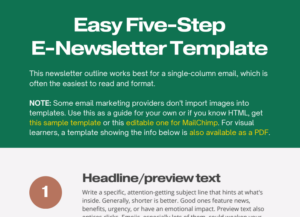
A partial view of the Easy Five-Step E-Newsletter Template.
  1. Quality: a layout should include mobile-friendly design and accessibility features. Responsive design automatically adapts the layout and content to fit any screen size, ensuring it’s readable on smartphones and tablets.
  2. Template Options:
    • Basic Layouts: Simple structures for easy content organization.
    • Industry-Specific: Imagery and layouts relevant to your field.
    • Multimedia: For videos and interactive content.
    • Curated Content: Information culled from various sources.
    • Product/Service Showcase: Highlight products, services, and special offers.
    • Event Promotion: Designed for upcoming promotions.

3. Text and Visuals: Put the most important information at the top to maximize engagement.

4. Legally-Compliant Footers: Anti-spam laws like CAN-SPAM (U.S.) and GDPR (Europe) ensure responsible email marketing.

Resources:

Many email marketing platforms offer customizable templates for professional, attractive, and on-brand newsletters.

What is a Sample Business Newsletter?

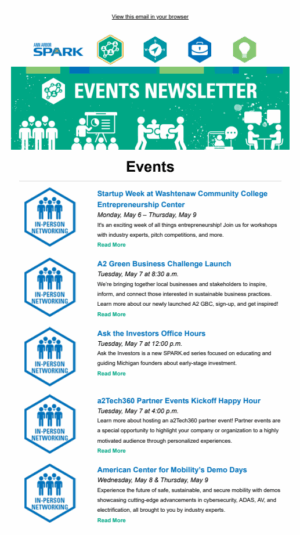
The Ann Arbor SPARK (AAS) e-newsletter follows many of these best practices:

  1. Compelling Headline: Entice readers to open the email.

Instead of their usual headline, “Check out these upcoming events in Ann Arbor!,” AAS could feature an event or a common theme.

Example: 14 Must-Do May Events in the Ann Arbor Area

It copies the headline of one of the feature articles (only cutting and pasting is required 🌝).

  1. An Engaging Content Structure: A clear and concise layout with informative, audience-focused information (e.g., news, testimonials, CTAs).


Among the newsletter examples for business: The Ann Arbor SPARK e-newsletter features a clear layout coupled with eye-catching design and content.

The clear format, with colorful headings and images separating the events from the features, ignites interest. The events section could be organized into two columns by date to reduce scrolling.

  1. Visual Appeal: Quality images, consistent branding, and readable fonts foster engagement.

The AAS e-newsletter engages well. But larger heading text, descriptive alt-text for images, and more instructive CTAs (beyond “Read More”) could enhance accessibility and interest. The CTA “lead in” text, however, emphasizes the benefits readers can expect well.

The AAS e-newsletter is one of the best newsletter examples for business. It effectively merges a clear layout with impactful visuals to form a must-read message.

Effortless Business E-Newsletter Creation

Making a newsletter without proper tools is like baking a cake from scratch — it’s time-consuming. With the elements of an effective business newsletter, you can create your own faster.

If you’re unsure where to start or lack time, explore my e-newsletter packages or get a free audit.

5 Steps to Write a Good Newsletter Article for Business


A "mail" icon on a computer screen. Testing how your emails look in email software can help you write a good newsletter.

1. Explore Your “Why” to Get to Your “What” – Businesses usually send newsletters to get more leads. How do you write a good newsletter article? If you know why you’re sending a newsletter and have already decided on a theme for it, fit your article into that overall topic. Otherwise, brainstorm subjects based on any existing customer data or what’s trending.

To refine your topic, link your article goals to the different stages of the buyer’s journey: Awareness, Consideration, and Decision-Making. Artificial intelligence software can prompt ideas that align with your customer data and your goals, too. 

2. Finding the Format: Another Way to Generate an Engaging Topic – Narrowing down the subject refines the article template. The format may also frame the topic. Common newsletter articles include:

  • A news brief
  • An editor’s or “welcome” note
  • A teaser for a blog post

3. Consider Storytelling – Your article should be useful, or in marketing terms, offer value. To help readers identify with you, tell a story. Michael Katz, who teaches professionals how to understand marketing, details his storytelling method effectively. To find good stories, list interesting things you saw or experienced recently, such as a colorful rainbow or a fun trip. Think about experiences you’ve shared.

Tie one to a useful business lesson or insight connected to your expertise. Then describe the experience, elaborating on the lesson. 

Example: HORNE newsletter: Uphill Goals and Downhill Habits

4. Get Organized – Newsletter articles tend to be brief and pull text from other sources, like blogs or landing pages. Research, is easier before you draft an outline. As you plan the beginning, middle, and end, outside of listicles, consider the basic AIDA format (Attention, Interest, Desire, and Action). When you write, follow the guidelines outlined in the AMA Handbook of Business Writing, which include using a title that attracts curiosity and short, focused paragraphs.

5. Prepare Your Article – To apply the finishing touches, edit and proofread and check for scannability and accessibility. Ensure the content has breathing room and that it follows a logical order throughout.

This is a shorter version of How to Write a Newsletter Article, which covers the process more in-depth and features advice about using artificial intelligence and interesting quotes.

How do you write a good newsletter article? Feel free to comment below.

Quotes

“You can’t go wrong by providing value to your readers. If you know your readers well and you have expertise that can help them solve some of their common problems, email newsletters are a great place to share that expertise. But make sure to provide content that is truly unique and informative. You want to make sure you’re offering value and not adding to the clutter.” ~ Kathy Bryan, Electives

“A personal story is effective because you can tie it into writing a newsletter article effortlessly.” ~ Carmine Mastropierro, How to Write a Newsletter: Step-by-Step Guide

Comments? Suggestions? Need help with your communications? Contact me.

5 Ways to Boost Your Writing Style and Tone for Business

1. Know the purpose of your document. Let it determine the appropriate writing style and tone.

  • Emails: People often write them like they speak, with relaxed language, using contractions and slang (“Let’s talk soon.”). Depending on company culture, internal memos may use more formal wording, forgoing humor and emojis. It may use neutral pronouns to remove potential bias.
  • Articles, web pages, newsletters, social media, and blog posts: Those that inform can include more neutral wording than those that entertain. If you want to interest people in buying a product or a service or to support something, you may use persuasive wording with psychological triggers, like emails warning of a sale that will end soon.
  • Crisis communications: When an emergency strikes on a mass scale, consider the gravity of the situation. Serious topics, such as widespread layoffs, a mass killing, or a harmful virus need care and sensitivity. Depending on the circumstances, it’s more empathetic to deliver the news by phone, video, or in person.

2. Simplify. Large blocks of text can be hard to read online, especially without proper formatting. Shorter words, sentences, and paragraphs free of jargon are easier to read. Add a list or bullet points to reduce blocks of text to improve scannability. Write in an active, rather than a passive voice, which fosters complex words and phrases.

3. Clarify. Explain complex concepts. Use examples. Add links to boost comprehension and save words. Insert images if they will enhance your explanation.

4. Show empathy, respect, and sincerity. Think about who your reader is, where they’re at, and what they struggle with.

  • End your email with a greeting.
  • Use the words “please” and “thank you” as appropriate.
  • Consider writing for inclusivity: different races, ethnicities, and people with disabilities.
  • Consider how readers from another culture may interpret your message.

5. Proofread. As a Forbes article declared, typos, especially lots of them, can make you look sloppy or “kill your brand.” Spell-checking software maker Grammarly reported in their study of 100 LinkedIn profiles of native English speakers that it can affect a professional’s ability to be promoted. They found that the profiles of people who weren’t promoted to a director-level position in the first ten years of their careers had 2.5 more errors than those who advanced.

Need to improve the tone or other parts of your writing to boost your image and your success? Consider a business writing coaching session.

BOOK A COACHING SESSION

What kind of tone works for you in your writing? Feel free to comment below.

Quotes

“Don’t you type at me in that tone of voice.” ~ Anonymous

“A writer doesn’t have a soundtrack or a strobe light to build the effect she wants. She has conflict, surprise, imagery, details, the words she chooses, and the way she arranges them in sentences.” ~ Adair Lara