How to Write a Law Firm Newsletter

If you’re unsure how to write a law firm newsletter, your emails might disappear in clients’ inboxes. The only response you get could be the sound of silence.
You’re right to be concerned. SmartInsights reports that the average email open rate for the legal industry is 33.2 percent, with a 1.6 percent clickthrough rate (CTR). There’s plenty of room for improvement.
So, how can you get attention?
By the end of this post, you’ll know how to create a law firm newsletter clients want to read.
We’ll explore practical tips, real-world examples, and resources to help you save time. You’ll learn where to place content to catch interest and nurture client relationships, transforming your newsletter into a tool for network building, law firm promotion, and growth.
Table of Contents
What is Email Marketing for Attorneys?
Email marketing for law firms involves sending promotional messages to build awareness and bonds. E-newsletters are usually more educational than email campaigns, which are designed mainly to sell.
Unlike social media posts or ads, like a website, e-newsletters can merge with a firm’s marketing mix to foster connections over time.
Law firms often attract email subscribers with problem-solving lead magnets (ebooks, guides, webinars). For example, Massachusetts-based O’Connell Law, LLC promotes a free estate planning guide.

The Real-Life Advantages of Email Marketing for Lawyers
My law firm e-newsletters have gained leads through events, news, and resourceful blog posts. While I’ve created them, I’ve noticed how this low-cost advertising can increase interest and returns on investment.
How Email Marketing Benefits Law Firms
- Cost-Effective Outreach: A firm can reach clients at a fraction of the cost of traditional advertising. If you have fewer than 2,500 subscribers, you could send e-newsletters for free.
- Targeted, Personalized Messaging: Segment subscribers and tailor messages by interest, industry, or needs.
- Measurable Results: Use metrics like open and clickthrough rates to track campaigns and optimize strategies.
- Personal Communication: Law firm email newsletters reach clients directly. CallRail reports that many firms agree email is the best way to contact unconverted leads.
- Regular Engagement: Stand out through repeat advertising, staying top-of-mind, and nurturing leads. The American Bar Association (ABA) found that 86 percent of firms neglect to collect potential clients’ email addresses. Per the Marketing Rule of 7, a customer must see a message at least seven times before they will buy.
The ABA reports that 92 percent of the firms they surveyed mainly communicate with clients by email. About a third (32 percent) of those firms use email marketing. Sixty-six percent send client alerts by email, including 92 percent or more of firms with 100 or more lawyers. Thirty-five percent said they send individual, personalized emails to clients and 41 percent send email newsletters.
“Creating email newsletters is a great marketing tactic to capture your audience and slowly convert them into buying your product/services after regular promotional and personalized emails are sent to them….We mainly communicate and sell through emails and phone calls.”
Martin Gasparian, Owner/Attorney, Maison Law
How and Why to Show Your Expertise in Your Newsletter
Q&As and analysis display your skills and authority, enhancing trust. The knowledge you share builds your authority, especially on complex legal matters. Listing information sources or linking to them highlights your accuracy and credibility.
As a law firm ghostwriter, I know showing information sources can maintain accuracy, transparency, and search engine rankings.
Showing your ties to reputable legal organizations or awards you’ve received further emphasizes your expertise.
Average Law Firm Email Newsletter Metrics
| Source | Open Rate | Click-through Rate | Unsubscribe Rate |
| MailChimp | 32% | 3% | 0.19% |
| MailerLite | 42% | 2% | 0.37% |
Legal Email Marketing Best Practices: List-Building and Optimizing Strategies
- Define your target audience through asking questions like:
- Which legal services are they interested in?
- Which legal issues do they struggle with?
- Which questions do they have about my practice area or the legal process?
- What do they hope to gain from working with an attorney?
- What do they want to know about the law or legal system?
- Segment your audience by practice area, client type, or legal needs for targeted law firm newsletter content. What are some law firm newsletter topics?
- Build your email list legally and ethically with information, not sales pitches. Get clear consent and prioritize client education. Offer valuable resources in exchange for email addresses.
- Go beyond personalization by name and explore ways to customize your emails based on client interests and past interactions. Send them to appropriate list segments.
- Craft law firm newsletter content based on audience data that educates, informs, and positions your firm as a thought leader (sans the legalese).
How Do You Create a Law Firm Newsletter Template?
An ideal law firm email marketing template features a simple structure for easy reading and engagement.
In the Attorney at Work piece 5 Steps for Structuring Law Firm E-Newsletters to Increase Leads, I covered the following key elements:
- Using a one-column format for easy reading and scanning
- Placing the most important content (like headlines and calls to action) at the top in an inverted pyramid approach.
- Following the AIDA (Attention, Interest, Desire, Action) format for law firm newsletter content placement.
- Concise content (around 300 words) with visuals for skimmability.
- Limiting calls to action (CTAs) to two to keep readers’ focus
- Balancing 90 percent informative, 10 percent promotional content
- CAN-SPAM and GDPR compliance
Law firm newsletter templates with these aspects tend to be easier to compile.
A Law Firm Newsletter Template Example and More Free Resources
Crafting compelling newsletters can be time-consuming, but these resources can streamline the process.
Email Marketing Services: Consider a free trial or freemium plan from a platform like MailChimp or Constant Contact. They offer interfaces for designing and sending newsletters, with pre-built layouts, and basic analytics to track subscriber engagement. Keep aware that free plans often limit the number of emails you can send or subscribers you can manage.
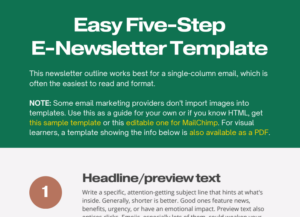
Content Curation: Stay up-to-date on legal issues and show your expertise with content from trustworthy organizations. The American Bar Association (ABA) website provides many legal resources you can reference. Consider including blurbs and links to relevant content to inform your readers.
The Easy 5-Step Business E-Newsletter Template offers an adaptable law firm newsletter layout. Its plain structure projects a professional image and boosts brand recognition.
Based on my experience with law and related firms, it removes the guesswork. It shows you where to place content to catch interest and nurture client relationships to grow your practice.
How Do You Write a Law Firm Newsletter?
When you have a plan, you can write email newsletters for law firms quickly.
Through regular e-newsletters, I’ve helped a law firm boost engagement ten percent, with click-through rates above industry standards.
In the Attorney at Work article 5 Steps to Writing an Engaging Law Firm E-Newsletter, I outlined the basics:
- Tailor the tone and content (formal vs. informal) to your brand, client base, and marketing goals.
- Per eye-tracking heat map studies, place the most important content at the top and to the left side.
- Use an informative, engaging structure, like a sales funnel, with clear CTAs.
- Craft compelling subject lines to boost interest.
- Apply popular headline writing formulas like Problem-Agitate-Solution (PAS) to spark curiosity.
Example: Preventing an Audit on the Final Tax Return
Headlines with specific terms tend to engage readers more.

As a MailChimp study showed, personalization can lower legal industry email open rates by 31 percent. To create a legal newsletter, avoid legalese, follow attorney advertising guidelines, and show clearly it comes from your firm. Educate your community as part of an organized informational campaign rather than a solicitation.
Add disclaimers to avoid potential liability for negligent misstatements.
Example: “This email is for informational purposes only. It doesn’t offer legal advice or create an attorney-client relationship.”
Test headlines, content, and formats for audience appeal. Segment your content by practice area to help readers find it quickly. Legal newsletters for clients should contain visuals like videos, images, and infographics to chunk text and build engagement. Encourage responses through comments, surveys, and polls.
“When creating e-newsletters for law firms, it can be a great idea to include hot-button current topics. Things like recent cases that have been in the news or recent new laws that are being debated are topics that will intrigue people and draw them in so that they’ll want to read more. This also provides you the opportunity to demonstrate your legal expertise to potential clients, which can help you win their business.”
Ben Michael, Attorney, M & A Criminal Defense Attorneys
Naming your newsletter can distinguish it. What are some law firm newsletter names?
For more strategies, see Writing a Business Newsletter and How to Create a Professional Email Newsletter. Find more writing advice in How to Write a Newsletter Article for Business.
Simple Steps for Addressing Email Accessibility
- As Knowbility suggests, use clear and concise language. Lose the legalese.
- Add alt text for images. Descriptive text helps visually or cognitively impaired readers or those using screen readers.
- Write descriptive link text. Instead of “click here,” use text that conveys the destination of the link (e.g., “download our free guide”).
- Use a sans serif font between 12 and 16 points.
How Do You Make a Legal Newsletter Look Professional?
Appealing newsletters for law firms look polished and speak to clients in your brand voice.
- Use brand colors consistently in your header or logo to establish recognition.
- Add quality, legal-specific images to enhance readability and messaging such as of your firm and your attorneys. Prefer original ones to posed stock photos, which can attract readers’ (and search engines’) interest.
- Easy-to-read fonts and consistent formatting create a clean and organized look.
- Edit and proofread for errors, consistency, clarity, and conciseness.
To boost brand awareness, feature informational content like news and recent blog posts. To increase sales, add product or service announcements, testimonials, or links to current offers.
What Are Some of the Best Legal Newsletters?
Though there are no best law firm newsletters, some exemplify best practices.
What are some legal newsletter examples? The following e-newsletters feature attributes of a good legal e-newsletter.
- The Law Office of Antoinette Bone’s Estate Echoes Newsletter
This issue features a clear, simple format with targeted CTAs. It was sent to professional service providers and serves as an example of email segmentation and personalization by the audience and their interests.
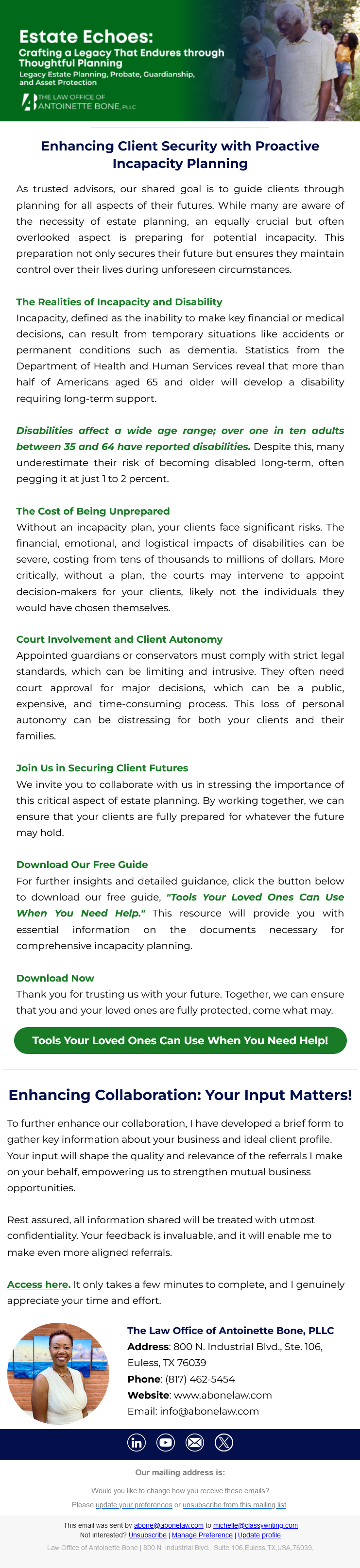
- Design: The logo includes the firm’s name and unique selling proposition, creating an appealing look.
- CTAs: Limiting CTAs to two per issue eases understanding and reduces confusion. A stronger first CTA (“The Tools Your Loved Ones Can Use When You Need Help”) could boost clicks. I’m often against references to clicks on buttons or links, but in this case, it clarifies where readers unfamiliar with web links can access the offer.
- Headings: Clear and colorful headings aid skimming.
- Body Text: The feature article spotlights incapacity through relatable statistics. Reducing the formal tone and the article length by 100-200 words would enhance readability and warmth.
- Accessibility: Adding descriptive “alt text” to images and hyperlinks to the footer could improve readability and clickthrough rates, as could a social media icon bar at the top.
Through a mix of educational and promotional copy, the e-newsletter addresses potential clients’ pain points and entices responses.
- Sundvick Legacy Center E-Newsletter
This email features a clear structure with an eye-catching logo, well-organized articles, colorful headings, and suitable graphics.
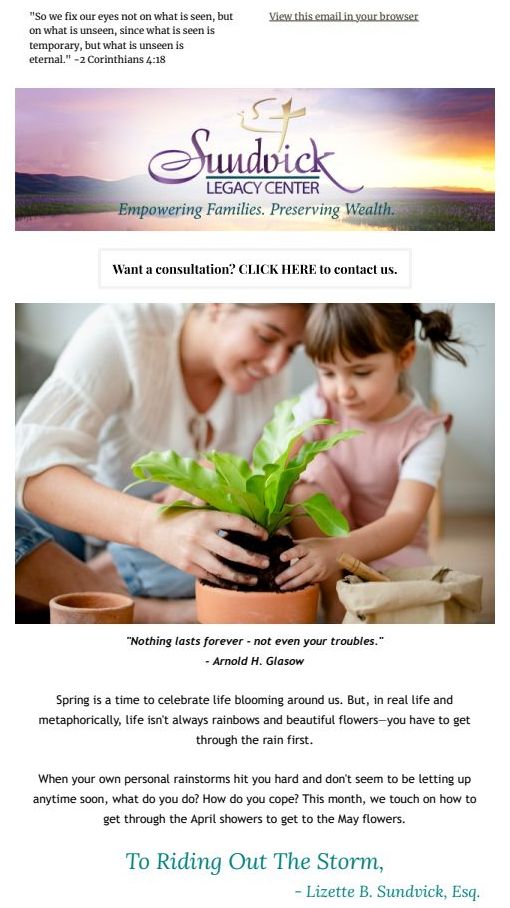
The “April showers bring May flowers” metaphor helps readers identify with life’s challenges.
It’s well-written at a fifth-grade level, though some sections could be tighter to enhance reading.
The welcome message adds warmth, while quotes and bible passages present the firm as a caring, values-based resource.
Recipes sometimes appear in service provider newsletters and I tend to question why. This one looks out of place. It might have been added to help readers relate to the firm, however, they could mention it’s a staff favorite. The e-newsletter would be shorter (and equally effective) without it.
Accessibility could improve with larger and descriptive hyperlink text, like replacing “click here” with “start your free consultation today.”
Some CTAs lack persuasive wording. Readers can easily answer “no,” to the question and skip the first one, which is well-placed, at the top. The blog post teaser could inspire more clickthroughs; the third item, on the women’s conference, uses scarcity well, yet could contain clearer wording.
Like the first newsletter, the firm’s contact information is clear. But without its physical address, the email fails to meet CAN-SPAM requirements.
Despite a few minor flaws, this e-newsletter shows how seasonal and informative content reinforces a firm’s values and expertise effectively.
Law Firm Newsletter Writing FAQ
- How do you create a legal newsletter?
To create an effective law firm newsletter, tailor content to your ideal client, prioritize education over sales pitches, and use a clear, scannable format with engaging headlines.
- What’s an example of law firm newsletter writing?
A good law firm newsletter example uses a clear format, targeted CTAs, and informative content that addresses potential clients’ concerns, like the Estate Echoes newsletter with its focus on incapacity and the Sundvick Legacy Center newsletter (both cited above) with its use of a relatable metaphor.
- How do you write content for a law firm?
Write for a law firm by tailoring content to your ideal client’s legal needs using clear language. Prefer educational information, yet add a touch of persuasion.
- How do you write a law firm newsletter template?
Law firm newsletter templates should emphasize easy reading with a one-column format, key info at the top, and balance informative content (90 percent) and CTAs (10 percent).
The template should also comply with CAN-SPAM, CASL, and GDPR data privacy rules. State your messages are ads. Be aware of attorney advertising rules in your jurisdiction and any state anti-spam laws. Given the sensitive nature of legal information, ensure your email service provider uses encryption and other security measures to protect client data.
- How do you write a law firm newsletter in PDF format?
Many of the steps outlined above for e-newsletters can also apply to those in PDF format. You can create one in PDF format by printing an existing e-newsletter and saving it as an Adobe PDF. To create one as a standalone PDF (apart from an electronic version), use tools like Canva, Microsoft Publisher, or Adobe Indesign; you can start with an existing template and adapt it to your liking. Then follow the basics of good e-newsletter writing outlined above.
Law Firm Newsletter Writing: Key Takeaways
- Targeted Content: Identify your ideal client and tailor your newsletter text to their legal needs and interests.
- Structure for Scannability: a clear, one-column format with concise content and visuals eases reading, skimming, and focus.
- Think Engagement: Craft compelling headlines and subject lines. Place the most important content at the top and to the left side.
- Inform and Educate: Offer valuable legal insights and resources without legalese. Prioritize client knowledge over sales pitches. Aim for around 90 percent of informational and 10 percent of promotional content.
- Compliance and Consistency: Ensure your newsletters meet CAN-SPAM, CASL, or GDPR rules and attorney advertising rules and any local anti-spam laws. Maintain a consistent sending schedule, format, content style, and tone to build brand recognition.
Many ABA survey respondents’ engagement agreements don’t address security concerns over emails or let clients unsubscribe. Seventeen percent reported their agreement provided disclosure and let clients opt-out. Another 18 percent said their agreement disclosed the issues but didn’t provide an opt-out. Thirty-eight percent reported “neither” and 27 percent don’t know if their agreement addressed this issue.
When emailing confidential information, 66 percent of respondents said they rely on the confidentiality statement in their message or subject line (25 percent) for security. Forty-four percent encrypted email communications, and 26 percent password-protected documents they emailed.
“When I’m advising professional services firms on writing e-newsletters quickly, I emphasize the importance of using templates to streamline the process. I recommend creating a content calendar to plan topics in advance, which helps in maintaining consistency and ensures the content aligns with clients’ interests and business goals. Leveraging AI-powered writing assistants can also significantly speed up the drafting process, allowing firms to generate engaging and relevant content more efficiently.
I’ve found that repurposing existing content, such as blog posts, case studies, and industry reports, can save time while still providing valuable insights to clients. I try to keep the e-newsletters concise and focused, using clear headings and bullet points to enhance readability and engagement. This approach not only saves time but also makes the newsletters more appealing and accessible to busy clients.”
Drew Thomas, CEO and Co-Founder, Kleene
A clear format and design form an appealing law firm e-newsletter. Strong educational and persuasive content completes a message that helps firms and their clients achieve their goals.
Now that you know how to write a law firm newsletter, the Easy 5-Step Business E-Newsletter Template shows what to add and where. Grab it to save time and stress less over your e-newsletters.
- Published: June 10, 2024
- Last changed: August 7, 2024